Forex backtesting
Forex backtesting turns currency strategy rules into measurable results.
A forex strategy should be tested with realistic costs, drawdown, and trade-by-trade review before a trader trusts it.
What makes a forex backtest useful?
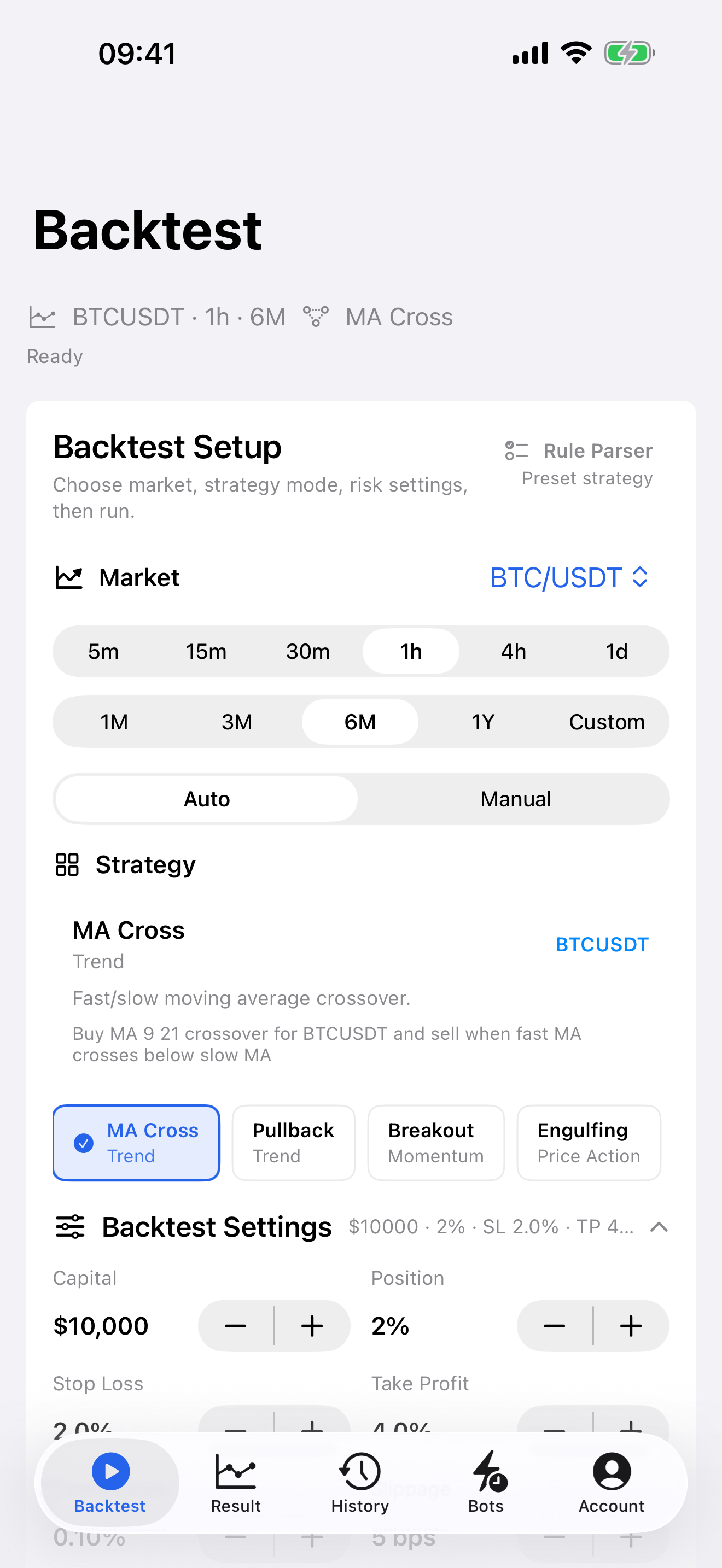
Useful forex backtesting defines the pair, timeframe, entry condition, exit condition, trade direction, position size, stop loss, take profit, and trading costs. This matters because small changes in spread, slippage, or timing can change the result.
Example forex test
A simple forex baseline could test EUR/USD or GBP/USD on 1H candles for 3 months, long and short direction, an RSI recovery rule with EMA trend filter, 1% stop loss, 2% take profit, and realistic slippage. Review whether losses happen after news-like volatility, during sideways periods, or when entries trigger too early.
Strategy examples
Forex traders can test trend pullbacks, moving-average crosses, breakout retests, RSI mean-reversion rules, MACD momentum signals, or manual rules described in plain text. Backtest focuses on showing the evidence: win rate, drawdown, profit factor, and the actual trades on the chart.
Related forex testing topics
After testing a currency pair, compare risk settings with the stop loss and take profit guide, or test momentum rules with the MACD strategy guide.
Test this setup in Backtest
Open the web app with the market, timeframe, and strategy from this guide already filled in. Adjust fees, slippage, stop loss, and take profit before running the test.
Run this EUR/USD forex setupImportant limitation
Forex backtests are historical simulations. They do not include every live execution condition and do not guarantee future performance.
Open Backtest app · More guides
Backtest Methodology: How Strategy Tests Are Calculated
Backtest Trading for iOS
Continue your research on iPhone
Run another setup, inspect every simulated trade, and keep your strategy research close at hand.
Download on the App Store