Strategy research · Updated July 13, 2026
Stop Loss and Take Profit Backtesting: Measure the Trade-Off
Reviewed by the Backtest Editorial Team · Editorial policy
Learn how stop loss and take profit settings change trade count, win rate, drawdown, profit factor, and the realism of a strategy backtest.
Quick answer
Stop loss and take profit settings are part of the strategy, not cosmetic inputs. They change the size and duration of losses, the frequency of winners, drawdown, and profit factor. Test them as a risk structure attached to one clear entry rule, with fees and slippage included, rather than searching for a percentage that makes one historical chart look best.
Why the trade-off matters
A tight stop may reduce the size of each loss but cause frequent exits in normal noise. A wide stop may increase the chance of staying in a trend while creating larger losses when the rule fails. A close target can raise win rate while capping winners; a distant target can lower win rate but improve average win. None of those relationships is automatically good or bad. The relevant question is whether the full result remains explainable after costs and across more than one market condition.
Backtest setup example
Keep the entry rule fixed: BTC/USDT, 1H, six months, Pullback, long-only, 2% position size, 0.10% commission, and 5 bps slippage. Run three deliberate variations: 1% stop and 2% target; 2% stop and 4% target; 4% stop and 8% target. Compare net result after costs, trade count, max drawdown, profit factor, average win, average loss, and the sequence of losses. Do not select the apparent winner until it is rerun on a different period.
How to read the result
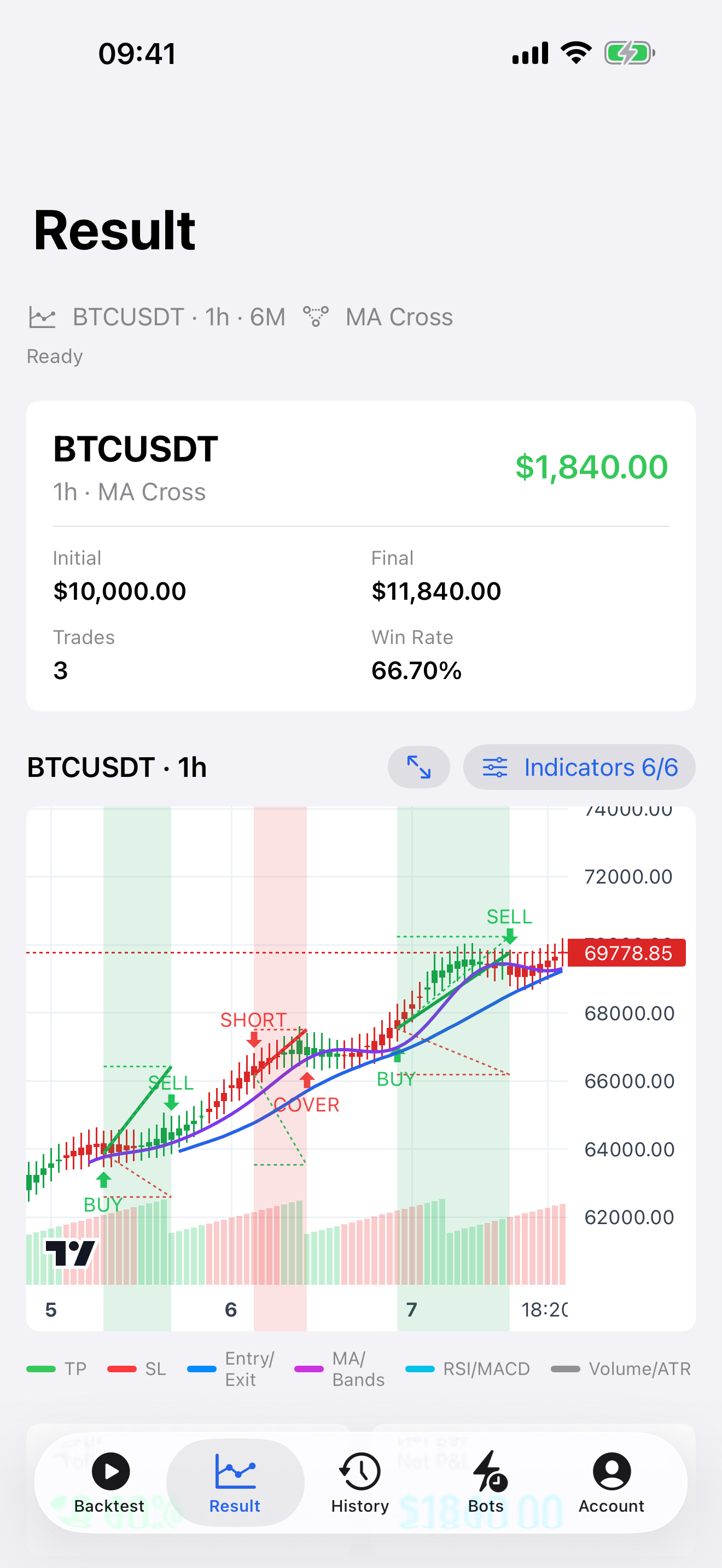
Win rate alone is often misleading. A setting with more winners may have small gains and infrequent losses that erase them. Profit factor puts gross profit beside gross loss, while drawdown shows the depth of the losing path. Open trades near the stop and target on the chart. If a stop is repeatedly hit just before the original trend resumes, investigate volatility and entry timing instead of immediately widening it. If winners often reverse before a distant target, inspect whether the exit rule needs more than one fixed target.
Execution assumptions matter
Historical simulation cannot know every intrabar path from a candle alone. Fees, slippage, gaps, and price-model assumptions can materially affect stops and targets. TradingView documents commission and fill modeling as part of its broker emulator; that is a useful reminder to keep Backtest settings conservative and transparent. Never present a stop/target result as a promise of future execution.
Risk note
Backtest is for education and strategy research. It is not financial advice, investment advice, a brokerage, an exchange, or an order execution platform. Historical simulation does not guarantee future performance. Trading can result in loss of capital. AI rule parsing and paper signal bots can be wrong and should be treated as research support only.
Research sources
Related guides
Backtest Trading for iOS
Continue your research on iPhone
Run another setup, inspect every simulated trade, and keep your strategy research close at hand.
Download on the App Store