Forward observation · No real orders
From Backtest to Paper Monitoring on Closed Candles
Reviewed by the Backtest Editorial Team · Editorial policy
Move a frozen backtest into observation-only paper monitoring, act only on closed candles, and audit signal parity without real orders.
Quick answer
After historical and holdout checks, freeze the exact strategy and monitor it on future closed candles with fictional capital only. Log candle close time, data source, signal inputs, expected action, paper event, and any mismatch. Do not place real orders, do not change the source setup mid-observation, and do not publish win-rate claims before a meaningful sample exists.
Closed-candle evaluation makes historical and forward logic easier to reconcile because the signal uses a completed OHLC bar. It does not remove latency, data revisions, gaps, or fill uncertainty. Paper observation is an operational and out-of-sample test, not proof of live profitability.
Research context
TradingView's official strategy documentation says strategies recalculate after a bar closes by default and warns that every-tick calculation can behave differently on realtime and historical bars, causing repainting after reload. This is the core reason to define whether a signal is allowed on an open bar.
Binance's official kline stream includes a boolean x field indicating whether the kline is closed. A production monitor can use an equivalent provider confirmation rather than guessing from local time. Backtest-specific observation should also deduplicate each symbol, timeframe, and close timestamp so reconnects do not create duplicate paper events.
QuantConnect describes paper trading as live data with fictional capital and simulated fills, explicitly not exchange-routed orders. Its documentation notes that the default model can differ in slippage and other brokerage behavior. The useful lesson is not that paper fills are realistic, but that model assumptions must stay visible.
Backtest app setup example
Begin with a saved Backtest candidate: BTCUSDT, 1h, six-month EMA(9/21) crossover, long only, $10,000 capital, 2% position size, 2% stop, 4% target, 0.10% commission, 5 bps slippage, signal-and-risk exits, and closed-candle evaluation. Confirm that its holdout result has already been recorded without retuning.
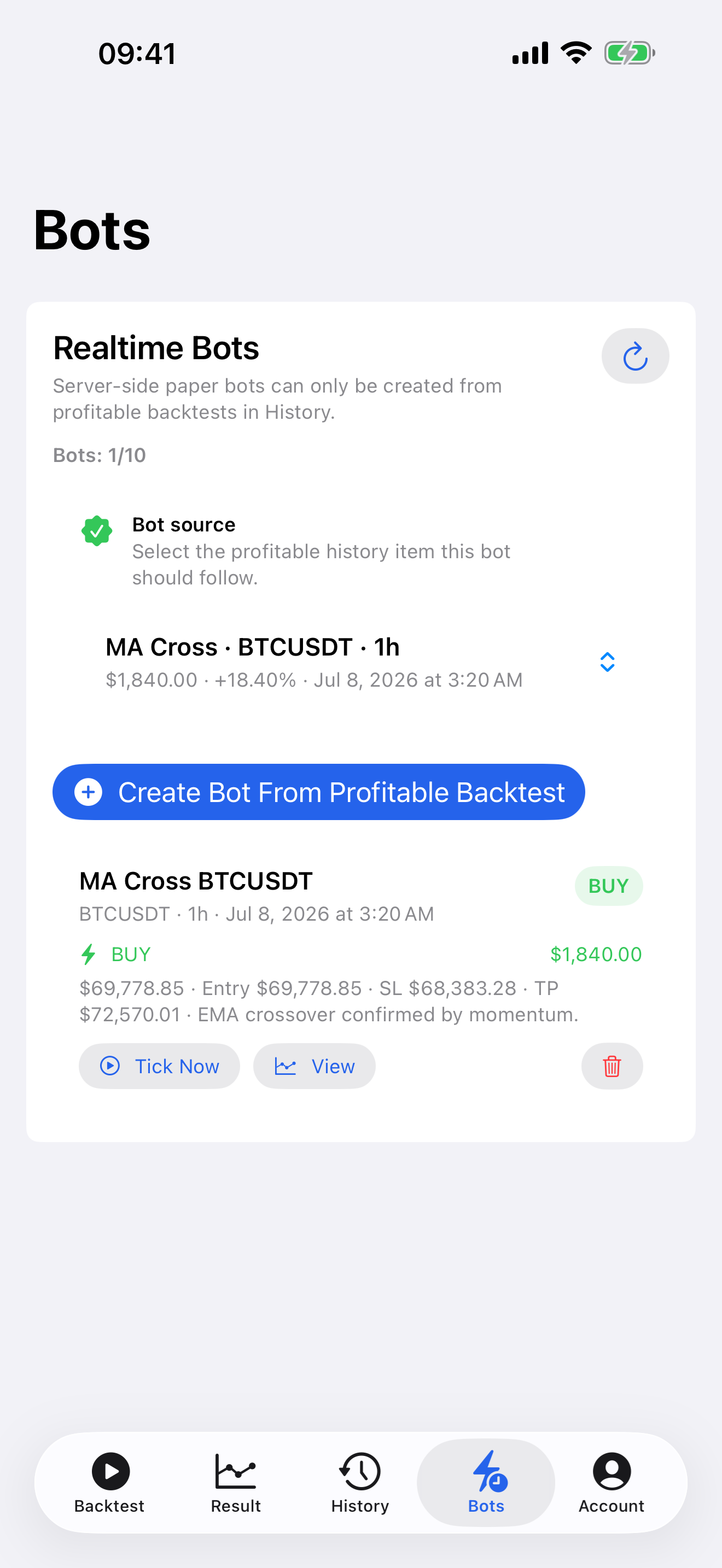
Create an observation-only paper bot from that exact saved history item. Lock the source fingerprint so controls on the current Backtest tab cannot override it. Set a planned observation horizon—for example 30 calendar days plus a minimum 30 closed signals, whichever takes longer. A low-frequency strategy may require a longer calendar window.
For each new closed candle, record provider close timestamp, ingestion time, source revision, indicator values, rule result, deduplication key, paper event, theoretical price basis, and notification status. Record data gaps and delayed candles as operational evidence instead of backfilling them silently.
How to read the results
First audit parity: did the same frozen rule produce the expected signal exactly once after the candle was confirmed closed? Investigate missing, duplicate, early, or late events before looking at P&L. Operational correctness is a prerequisite for any performance interpretation.
Next compare forward observations with the historical profile: signal cadence, direction mix, holding time, fees, excursion, realized paper R, drawdown, and regime context. Use the same definitions and fingerprint. Hide or qualify rates when the sample is below the predeclared minimum.
Separate model drift from infrastructure drift. Different market behavior may be legitimate out-of-sample evidence; a changed provider symbol, incomplete candle, timezone error, notification outage, or duplicated close is a system issue. Neither should be averaged away.
A monitoring incident log
Keep an incident record with event ID, expected close, observed close, source, rule hash, status, diagnosis, and resolution. Examples include provider delay, reconnect duplicate, missing candle, indicator warm-up, stale credentials, or notification failure. Do not edit historical events to make the dashboard look clean.
Pause conclusions when data integrity is uncertain. Resume with a documented boundary so later analysis can exclude the affected interval without hiding why.
When to stop or extend observation
Stop when a predeclared safety or integrity gate fails: rule fingerprint changes, repeated duplicate signals, unavailable data, drawdown beyond the research limit, or behavior that violates assumptions. Extend only for a reason written before seeing the performance, such as not reaching the minimum signal count.
Completing paper observation still does not authorize a real-money decision. It produces a richer evidence package that a user may consider independently with their financial circumstances and professional advice.
Operational parity before performance
Build a reconciliation table between the historical engine and the paper monitor. For each provider-confirmed close, store source symbol, interval, close timestamp, warm-up range, normalized candle values, indicator vector, rule fingerprint, expected signal, emitted event, and any suppression reason. A deterministic replay of the same closed data should produce the same decision. If it does not, investigate normalization, timezone, rounding, indicator warm-up, or version drift before interpreting returns.
Notifications are downstream delivery evidence, not the signal itself. Track signal creation, persistence, queueing, delivery attempt, and user-visible receipt separately. A failed push should not count as a missing strategy signal, while a retried delivery must not create another paper position. Idempotency keys and immutable event IDs allow reconnects, retries, and delayed workers without duplicating the research record.
Define stale-data behavior explicitly. The safe observation response to an incomplete candle, unavailable provider, clock skew, or unknown rule version is to record an incident and avoid fabricating a decision. Backfilling later may help diagnosis, but label it retrospective and keep it out of the contemporaneous paper track. This preserves the distinction between what the monitor actually knew at the time and what became available afterward.
Model a paper fill only after the signal event is fixed. Record whether the reference is next open, close, midpoint, or another deterministic basis; then apply the same commission and slippage convention used by the historical comparison or explain the difference. Never replace the observed basis with the best later price. Gaps, unavailable quotes, and a target-stop collision need explicit conservative handling rather than an assumed favorable fill.
Review the monitor by both calendar time and independent event count. Thirty quiet days may contain too little evidence, while hundreds of correlated signals during one shock do not represent many regimes. Report days observed, complete closes processed, eligible signals, positions, incidents, and missing-data intervals together. A longer horizon can add evidence, but extending it because early P&L looks disappointing is another moving goalpost unless the extension rule was written before observation.
Common mistakes
- Treating paper monitoring as live order execution or as a promise of obtainable fills.
- Acting on a still-open candle and later comparing it with closed-candle history.
- Changing indicators, parameters, costs, or risk settings during observation.
- Counting reconnect duplicates or silently filling missing candles.
- Publishing win rate, profit factor, or expectancy from a tiny sample.
- Ignoring provider timestamps, timezone boundaries, notification failures, or model assumptions.
Practical checklist
- Freeze and identify the exact saved backtest and holdout candidate.
- Require provider-confirmed closed candles and a unique close-event key.
- Create observation-only paper monitoring with no order-routing capability.
- Predeclare calendar horizon, minimum signals, integrity gates, and stop conditions.
- Log signal inputs, event timing, data revisions, paper fills, and incidents.
- Audit parity and infrastructure before interpreting paper P&L.
- Compare only with like-for-like historical definitions and disclose small samples.
- Keep real-money decisions outside the monitor and treat results as research evidence.
Risk note
Paper signals and fictional fills can be wrong and can differ materially from live trading. Backtest does not place real orders and is not financial advice, a broker, or an exchange. Real spreads, slippage, liquidity, queue priority, partial fills, gaps, latency, outages, fees, funding, taxes, and human decisions can worsen outcomes. Historical, holdout, and paper performance do not guarantee future results.
Related guides
Use like-for-like comparison, trade evidence, and a locked holdout before this stage. Together they create a research chain in which every step can reject the strategy.
Research sources
Backtest Trading for iOS
Continue your research on iPhone
Run the setup again, inspect every simulated trade, and keep the strategy evidence in the app.
Download on the App Store