Article contents
- Evidence and scope
- Illustration
- Process
- A process lasting several bars
- Freeze the zone and track the outside state
- Measure volume in distinct parts of the attempt
- Synthetic examples with a deadline and losing outcome
- Entry after reclaim or after a separate retest
- Compare failure with continuation, not only selected winners
- Common pitfalls
- Practical checklist
- Frequently asked questions
- Research sources
Evidence and scope
Original indicator descriptions, support/resistance research and exchange order documentation provide context. None validates the net profitability of this proposed multi-bar reversal strategy.
 Open full-size illustration
Practical workflow
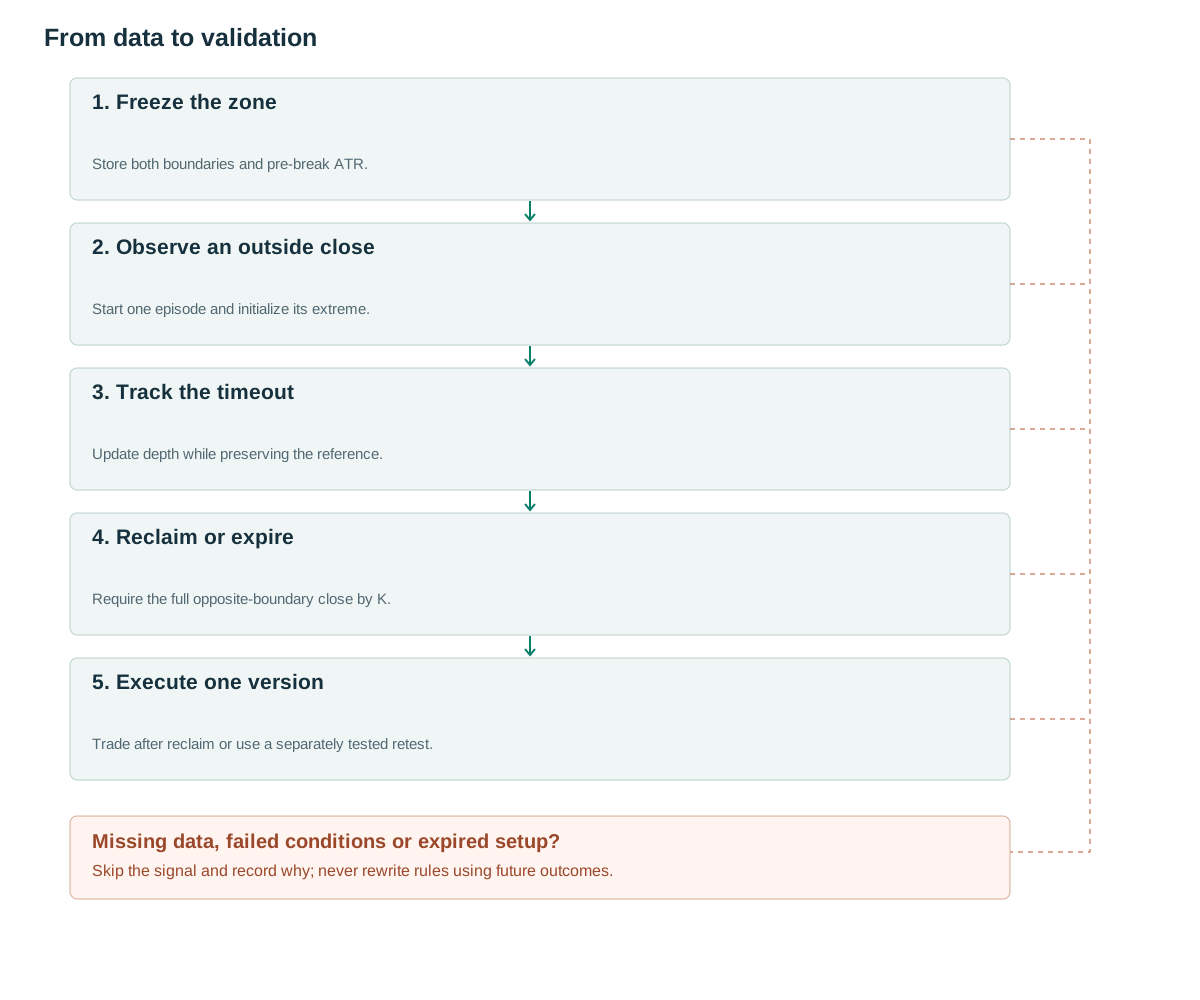
- Freeze the zoneStore both boundaries and pre-break ATR.
- Observe an outside closeStart one episode and initialize its extreme.
- Track the timeoutUpdate depth while preserving the reference.
- Reclaim or expireRequire the full opposite-boundary close by K.
- Execute one versionTrade after reclaim or use a separately tested retest.
A process lasting several bars
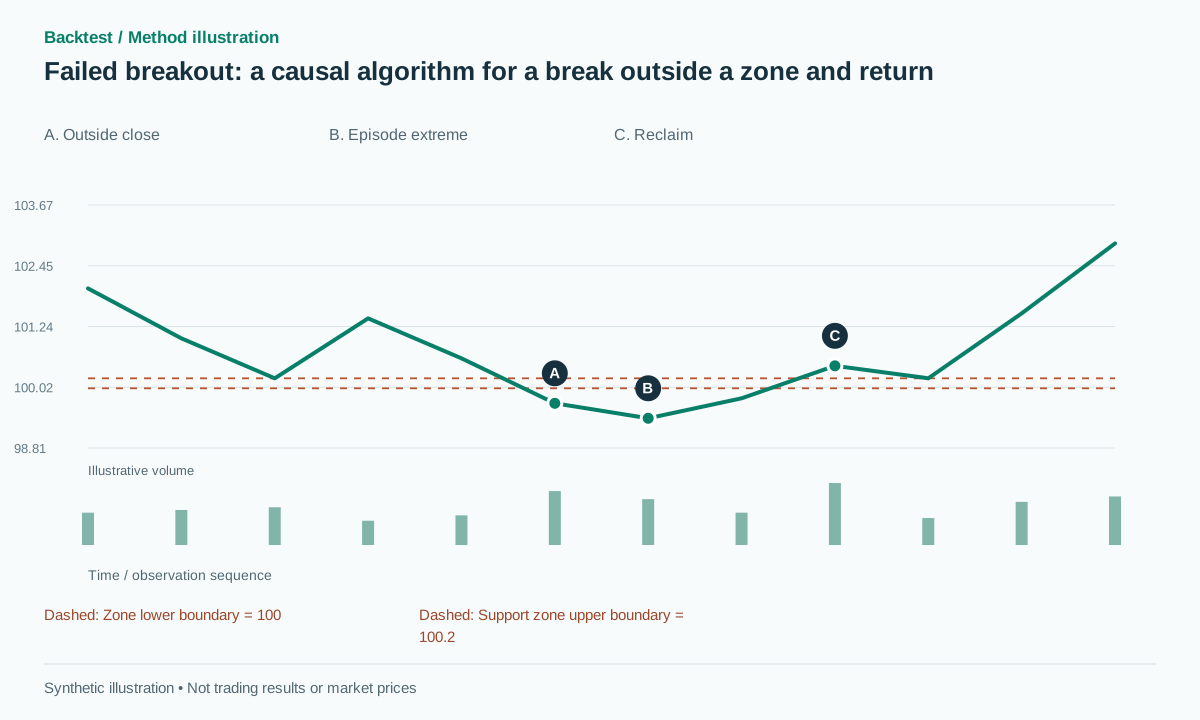
Consider support from 100 to 100.20. A close at 99.70 starts a break attempt; a subsequent close at 99.80 shows price is still outside. Only a later close above 100.20 plus the reclaim buffer establishes failure under the chosen definition. A trader at the first close cannot know this ending in advance.
The original Liquidity Sweeps description includes a close-break/retest branch [1]. Osler’s support/resistance research concerns levels in an FX sample [2], not this strategy’s returns. Requiring an earlier outside close keeps the proposed detector distinct from a single candle that penetrates and immediately reclaims.
The upside version closes above resistance and later returns beneath the zone. Trapped positions are a possible explanation, but OHLCV does not reveal how many traders are trapped. Store the observed path without converting a plausible narrative into measured inventory.
Freeze the zone and track the outside state
Use zone=[100,100.20] as an example, with pre-event ATR A. Proposed buffers are b=max(2 ticks,0.10A) and e=max(2 ticks,0.15A). The first close below zone_low−b records start, the current extreme, outside-close count and A_ref. Do not move the zone or recompute its normalization after volatility increases.
K=4 subsequent bars is a proposed research timeout. A reclaim requires a later close above zone_high+e by the deadline. Continue updating the lowest low while waiting. If no reclaim occurs, retain an expired episode; continued breakdowns are central evidence, not unwanted rows to remove.
Two acceptance policies must remain separate. One cancels after two outside closes; the baseline keeps waiting until K even after temporary acceptance. The example below uses the latter. Define boundary equality explicitly: a close exactly at zone_high+e does not satisfy a strict greater-than trigger.
The state machine should evaluate reclaim on the final eligible bar before expiry. Specify whether a new extreme during that same bar belongs to the stop calculation; this baseline includes it. These details prevent two implementations with apparently identical parameters from producing different trades.
if state == ARMED and C[t] < zone.low-b:
  state = OUTSIDE; start=t; extreme=L[t]
elif state == OUTSIDE:
  extreme=min(extreme,L[t])
  if t-start <= K and C[t] > zone.high+e:
    emit(RECLAIM, t, extreme); state=CONFIRMED
  elif t-start >= K:
    state=EXPIRED
# New entry only after RECLAIM is known
Measure volume in distinct parts of the attempt
Separate the initial break, the outside interval and the reclaim. Five bars naturally contain more total volume than one, so compare means or equal-duration windows. Same-time RVOL controls for the difference between active opening minutes and quieter periods.
One hypothesis is a weak-volume break followed by a stronger reclaim. Another is extremely heavy volume that produces little additional progress before reversal. They describe different conditions and should be tested separately. Calling both volume confirmation after the outcome is known makes the rule unfalsifiable.
A widening spread can also matter. A reclaim in last-traded price might leave a poor executable bid or ask. Store quotes when available and express costs relative to the proposed stop distance. High activity is not a guarantee of inexpensive execution.
Synthetic examples with a deadline and losing outcome
Let the zone be 100–100.20, A=1 and tick=0.01, giving b=0.10 and e=0.15. Successive closes are 99.70, 99.80 and 100.45, with the lowest observed price at 99.40. The third close exceeds the reclaim threshold of 100.35. A buy filled at 100.50, stop at 99.30 and target at 102.90 has risk 1.20 and reward 2.40. It becomes a winning trade only if the subsequent executable path reaches the target before protection.
In a losing path, the same reclaim is followed by a decline to 99.20 and a stop fill at 99.25. The loss is 1.25 per unit. A correctly detected failed breakout can therefore produce a losing trade; detector validity and economic success are different labels.
If reclaim arrives at start+6 when K=4, the episode has expired. Do not extend the deadline to rescue it. A close at 100.25 has returned above the zone but has not passed the full reclaim threshold. A softer trigger is a new version, not a reason to relabel this observation.
Entry after reclaim or after a separate retest
The baseline submits after receiving the reclaim close. A slower variant waits for a retest from above and a holding close, with its own TTL measured from reclaim. If price runs directly away, record no-fill rather than silently changing into a chase entry. Match order behavior to the chosen market [3].
Before entry, a further break beyond the event extreme plus buffer or unreliable data can cancel a waiting candidate. After entry, a stop outside the extreme is one risk model; an ATR stop around entry is another. A fixed R multiple or the opposite side of a previously frozen range can be the target, provided the choice precedes the outcome.
Use at most one trade per break attempt in the baseline. Repeated closes after reclaim are not independent attempts. A new candidate requires a specified re-arm condition after price leaves the area. Changing the calendar date must not erase an existing position or its outstanding protective orders.
Compare failure with continuation, not only selected winners
Evaluate every episode from its first outside close. Report reclaim frequency within K, excursion depth, return time and net trading results. A high reclaim rate can coexist with negative expectancy when stops are wide or most of the rebound occurs before entry.
Controls should share time of day, volatility and reference type. Compare accepted breaks with failed breaks and test rolling levels against discretionary zones. Cluster overlapping episodes by day or market event when estimating uncertainty; otherwise many observations from one shock create artificially narrow confidence intervals.
Inspect parameter neighborhoods for K, both buffers and the acceptance rule. Preserve an untouched time-based test set. Also compare episode-level performance with calendar-level performance: a filter can improve average trade quality while removing enough opportunities to reduce total returns on the allocated capital.
Common pitfalls
Calling failure at the first break
Without a later reclaim, the observation is only a break attempt.
Extending the deadline after inspection
Moving K to fit the chart leaks the outcome into candidate selection.
Turning one sequence into many trades
Several post-reclaim closes do not represent independent episodes.
Checklist before using this method
Check each item after verifying it on your data. Progress is saved in this browser; it does not certify a profitable strategy.
Frequently asked questions
How does this differ from a one-bar sweep?
This definition requires a completed outside close before the reclaim bar. A single-bar sweep may never close outside at all.
Can a high-volume breakout fail?
Yes. Volume describes activity, while the subsequent path determines this event label. Whether it predicts profitable returns requires a separate execution-aware test.
Research sources
Each source supports the definition or evidence described beside it. The pseudocode, synthetic examples and proposed parameters require separate validation.
- Liquidity SweepsLuxAlgo on TradingView. Read the original description; the indicator code was not run or audited. Checked: .
- Support for ResistanceFederal Reserve Bank of New York. Read the original research announcement; it does not report results for this variant. Checked: .
- Futures Order TypesCME Group. Read exchange order mechanics, not evidence of strategy profitability. Checked: .
Related methods
Risk note
This content supports education and research design, not financial advice. Backtest is historical simulation, does not guarantee future performance and does not place real trades. Methods in this library are not automatically features available in the app. See methodology and learning center.
Validate rules before risking real capital
Check app support, data and individual simulated trades; advanced detectors may require a separate implementation.
Download Backtest on the App Store