Article contents
- Evidence and scope
- Illustration
- Process
- Observable behavior and the reversal hypothesis
- A causal detector with proposed research parameters
- Volume measures activity, not the identity of the trader
- Synthetic examples: a valid event, a rejection and a loss
- Entry alternatives must remain separate strategies
- Test the incremental value of reclaim
- Common pitfalls
- Practical checklist
- Frequently asked questions
- Research sources
Evidence and scope
An original indicator description and research on stop-related price cascades provide context. The proposed detector has no new backtest or independently verified trading record here.
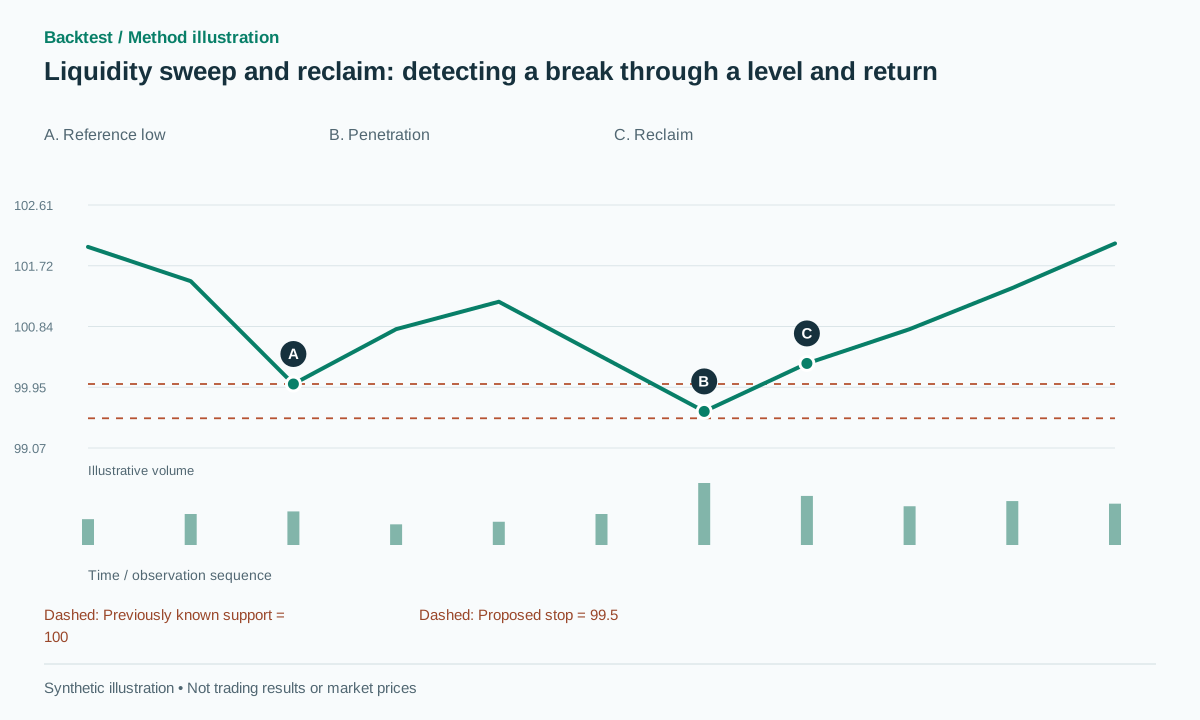 Open full-size illustration
Practical workflow
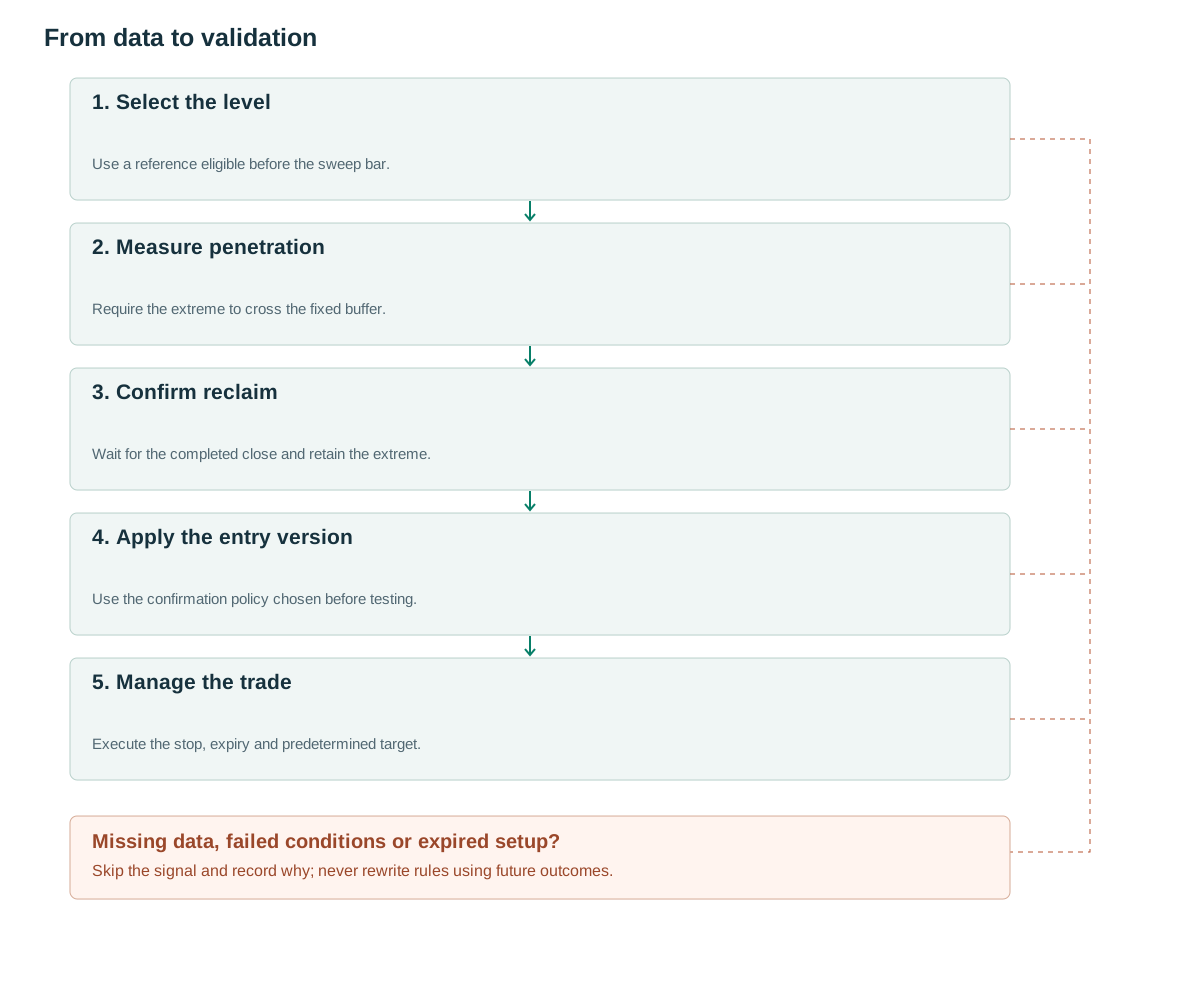
- Select the levelUse a reference eligible before the sweep bar.
- Measure penetrationRequire the extreme to cross the fixed buffer.
- Confirm reclaimWait for the completed close and retain the extreme.
- Apply the entry versionUse the confirmation policy chosen before testing.
- Manage the tradeExecute the stop, expiry and predetermined target.
Observable behavior and the reversal hypothesis
Suppose support at 100 was established before the current event. Price trades down to 99.60 and closes at 100.30. The downward extension did not persist until the close. The useful research question is whether an executable entry after that return has better subsequent returns than a matched control. Whether an institution deliberately hunted stops is a different question, which OHLCV cannot answer.
LuxAlgo describes wick sweeps and break/retest alternatives [1]. This article fixes the single-bar reclaim version. CME explains stop-order mechanics [2], while Osler studies stop-related cascades in FX [3]. Those references motivate retaining continued moves through the level as controls; they do not establish profitability for this reversal rule.
A reference can be a confirmed pivot, the previous session low or a cluster of equal lows. Store reference_type, age and prior touches. When one price level has three descriptive names, treat it as one underlying event rather than three independent opportunities. Otherwise a backtest can exaggerate both sample size and diversification.
A causal detector with proposed research parameters
Before bar t begins, obtain an eligible support S and ATR14 from t−1. Proposed buffers are b=max(2 ticks,0.10 ATR) for penetration and e=max(2 ticks,0.15 ATR) for reclaim. A bullish event requires the previous close at or above S, the current low below S−b, and the current close above S+e. Reverse the inequalities around resistance for the bearish version. Missing ATR or an inappropriate tick-to-volatility relationship makes the candidate ineligible.
A pivot located at bar i but requiring r right-hand bars is not known until i+r. A conservative implementation makes the resulting level eligible on the following bar. Drawing the line backward to the pivot location must not make it available to earlier sweep decisions.
Record penetration depth in ATR units and close location, CLV=(close−low)/(high−low). A high CLV means the close is near the bar high. Treat it as a feature to evaluate, rather than automatically discarding every lower-CLV event. Handle zero-range bars explicitly. Keep the reference level and buffers fixed throughout the candidate lifetime.
before_t = snapshot(levels eligible before t)
A = ATR14[t-1]
for S in before_t:
  if C[t-1] >= S and L[t] < S-b and C[t] > S+e:
    emit(signal_at=close_time[t], extreme=L[t], level_id=S.id)
# Place orders only after the confirmed close is received
Volume measures activity, not the identity of the trader
One proposed feature compares the sweep bar with the same time slot in the previous 20 sessions. High volume can accompany aggressive selling, buying against that selling, or both. Test high-RVOL and low-RVOL sweeps separately before choosing a combined rule. Selecting a different explanation after seeing which trade won defeats the purpose of a detector.
If trade records reliably identify the aggressive side, measure delta around the extreme. Heavy aggressive selling with little further downward progress is an absorption candidate, which still needs subsequent price confirmation. Red candle volume is not equivalent to aggressive sell volume. FX tick volume represents activity in the observed feed, not consolidated global turnover.
Normalize the denominator consistently across regular and extended sessions. A low-volume midday reclaim should not be compared with opening-auction volume merely because both bars are five minutes long. If the baseline is missing or zero, record insufficient data rather than assigning an enormous RVOL.
Synthetic examples: a valid event, a rejection and a loss
Let S=100, ATR=1 and tick size=0.01, giving b=0.10 and e=0.15. A bar with O=100.20, H=100.60, L=99.60 and C=100.30 penetrates below 99.90 and reclaims above 100.15. Its CLV is 0.70. If a buy executes at 100.35 after the close is received, a stop at 99.50 and target at 102.05 produce initial risk of 0.85 and reward of 1.70, or 2R before costs. These numbers are synthetic arithmetic, not market results.
With the same low but a close of 99.95, the reclaim condition fails. In a separate losing path, the valid signal fills at 100.35 and the following bar gaps through protection, producing an exit at 99.42. The loss is 0.93 rather than the planned 0.85. The trade cannot be deleted because its stop execution was unfavorable.
A bar that crosses both boundaries of a trading range is ambiguous without intrabar sequencing. Its close does not reveal which boundary was crossed first. Flag that case or use finer-grained records sufficient to resolve the order; do not choose whichever direction subsequently wins.
Entry alternatives must remain separate strategies
An early version submits after the reclaim close. A delayed version waits for a later close above the reclaim bar high. A structure version waits for a break of an already confirmed minor swing. More confirmation can reduce some false signals while moving entry farther from the stop. Compare net expectancy rather than assuming confirmation is always beneficial.
For a waiting candidate, K=4 bars is a proposed expiry. A break below the sweep extreme minus b before entry cancels it. Once a position exists, an intrabar protective stop and a close-based invalidation are different instructions. A stop active during the bar cannot disappear from the simulation simply because price subsequently recovers.
Store signal_at, received_at, submitted_at and filled_at. A buy limit placed after reclaim may never fill, and a mere touch does not guarantee queue execution. Use a preselected R target or a resistance level that was known at entry. A future swing high cannot retrospectively become the intended target.
Test the incremental value of reclaim
Begin with all penetrations of the same reference type, including those that never reclaim. Match controls by time of day, volatility, trend and level age. Then add reclaim, RVOL and structural confirmation in separate experiments. Split observations chronologically and preserve a final test set that is not used to revise thresholds.
Report independent event counts, net R, drawdown, adverse and favorable excursions, and no-fill rates. Several signals generated by one excursion should share event_group_id. Confidence intervals based on individual bars can be misleading when the observations belong to the same market shock.
Replay each historical prefix and verify that appending future bars cannot alter previously published levels, signals or timestamps. Also test levels exactly at buffer boundaries, multiple overlapping references, missing bars and tick-size changes. A detector that works only with one convenient bar alignment deserves a weaker conclusion than one that survives adjacent session offsets.
Common pitfalls
Calling every wick a stop hunt
A wick establishes an extreme, not the participants or their intention. Keep the detector name descriptive.
Counting repeated information as confirmation
Sweep, pin-bar shape and CLV may encode the same candle. Use ablation to measure additional information.
Improving the entry retrospectively
A signal known at the close does not permit a purchase at the earlier wick low.
Checklist before using this method
Check each item after verifying it on your data. Progress is saved in this browser; it does not certify a profitable strategy.
Frequently asked questions
Does a valid sweep require high volume?
Not in the geometric baseline. Evaluate outcomes across RVOL groups; requiring high volume creates a separate strategy version.
Should an upside sweep always be shorted?
No. A penetration that closes above the level belongs to a breakout or acceptance hypothesis. Even a full reclaim can subsequently fail.
Research sources
Each source supports the definition or evidence described beside it. The pseudocode, synthetic examples and proposed parameters require separate validation.
- Liquidity SweepsLuxAlgo on TradingView. Read the original indicator description; the script was not executed or audited. Checked: .
- Futures Order TypesCME Group. Read order mechanics; this does not validate the detector. Checked: .
- Stop-Loss Orders and Price Cascades in Currency MarketsFederal Reserve Bank of New York. Read Carol Osler’s research abstract; its empirical scope is FX. Checked: .
Related methods
Risk note
This content supports education and research design, not financial advice. Backtest is historical simulation, does not guarantee future performance and does not place real trades. Methods in this library are not automatically features available in the app. See methodology and learning center.
Validate rules before risking real capital
Check app support, data and individual simulated trades; advanced detectors may require a separate implementation.
Download Backtest on the App Store