Article contents
- Evidence and scope
- Illustration
- Process
- What the source author actually describes
- Select an extended candidate, then wait
- Volume gives context, not proof of exhaustion
- A timed winner and a squeeze after entry
- Borrow and order sequencing are strategy rules
- Measure loss tails before trusting win rate
- Common pitfalls
- Practical checklist
- Frequently asked questions
- Research sources
Evidence and scope
The author publicly associates parabolic shorts with one of three setups behind his self-reported profits. Charts and an FAQ do not independently verify each setup’s performance. The mechanical specification below has not been backtested here.
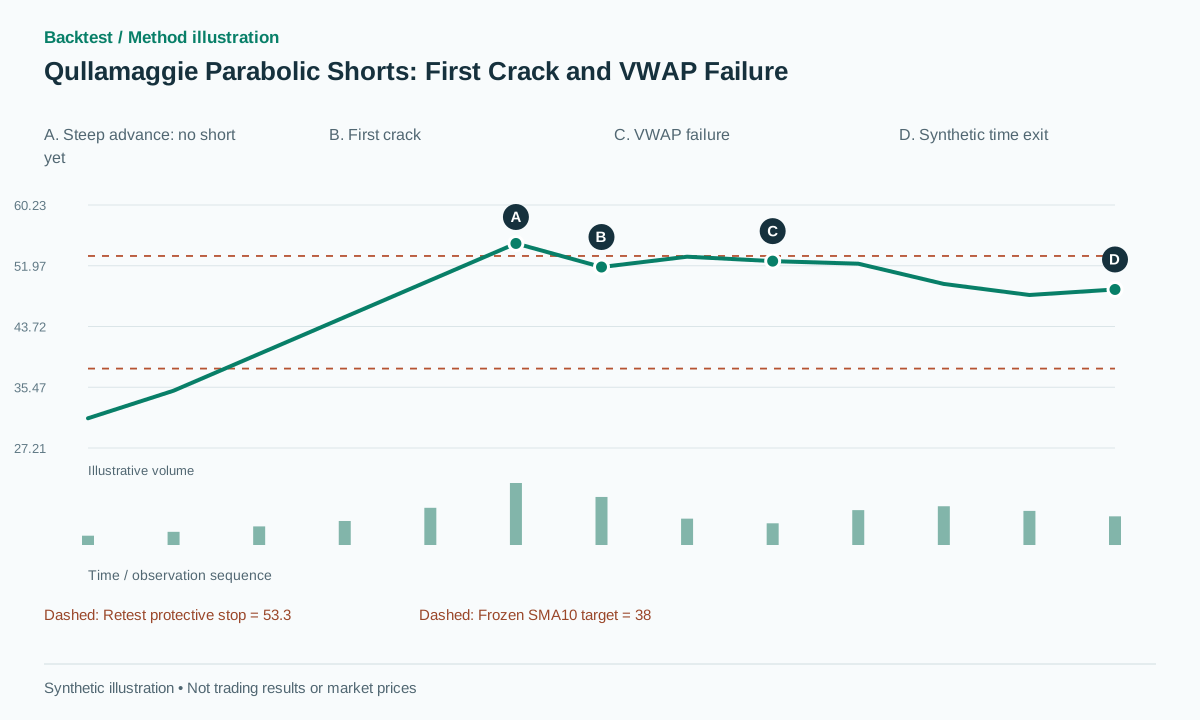 Open full-size illustration
Practical workflow
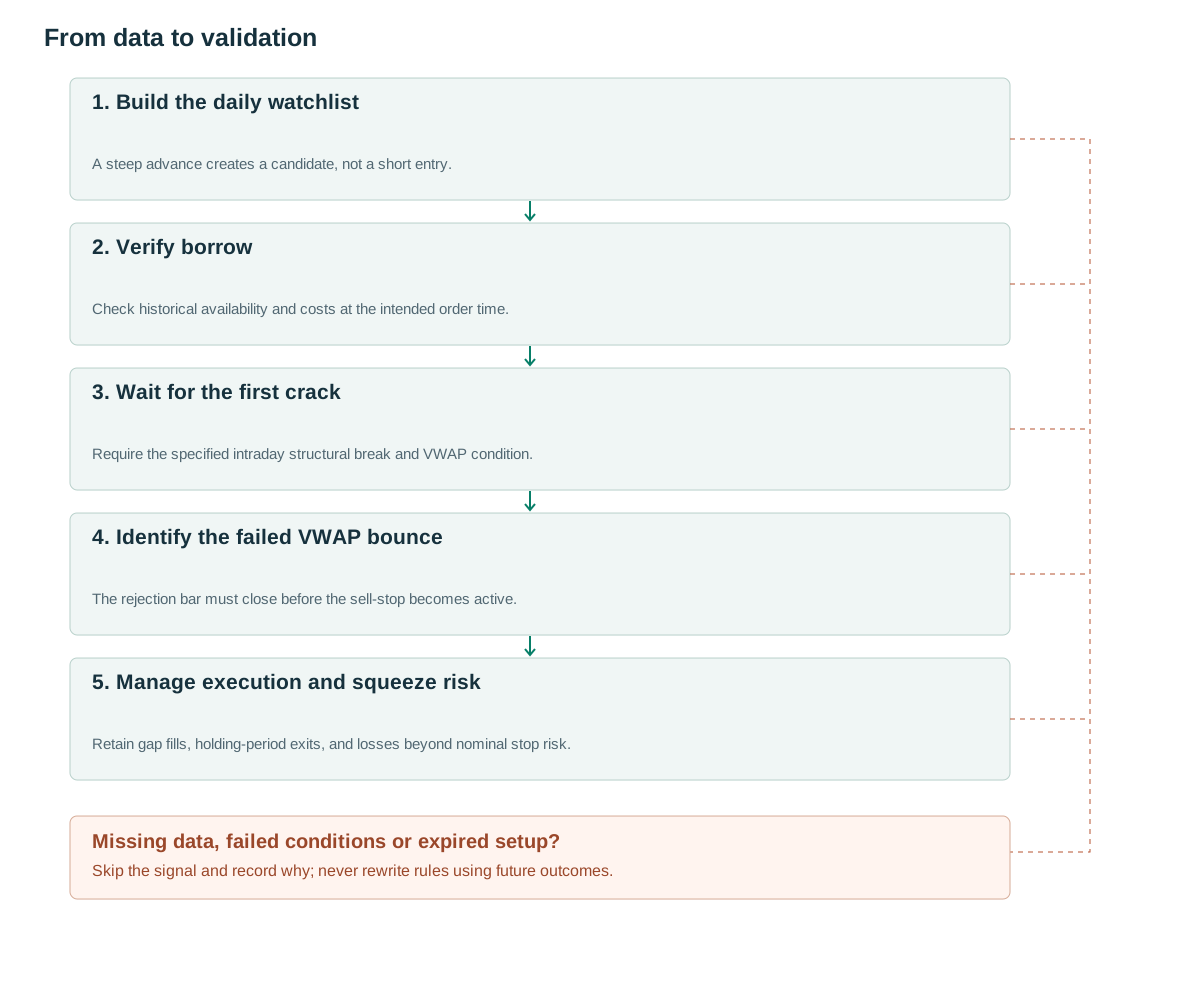
- Build the daily watchlistA steep advance creates a candidate, not a short entry.
- Verify borrowCheck historical availability and costs at the intended order time.
- Wait for the first crackRequire the specified intraday structural break and VWAP condition.
- Identify the failed VWAP bounceThe rejection bar must close before the sell-stop becomes active.
- Manage execution and squeeze riskRetain gap fills, holding-period exits, and losses beyond nominal stop risk.
What the source author actually describes
Qullamaggie describes a strong multiday advance followed by entries around an opening-range low or a first crack and subsequent VWAP failure. His discussion includes stops near the day's high or VWAP and moving-average target areas around the ten- and twenty-day averages [1]. The process waits for a reaction; it is not a rule to short every stock above an arbitrary percentage gain.
His FAQ discusses access to good, sometimes expensive locates [2]. Two traders viewing the same chart may therefore face different feasible trades. A backtest that permits shorting every candidate can misrepresent the tradable universe before win rate or entry timing is even considered. Historical borrow access is part of the experiment.
The public material contains multiple variants and discretionary judgment. This article selects the first-crack-to-VWAP-failure branch and supplies explicit numerical rules. The author's name identifies the accessible inspiration; the thresholds below are this article's research choices and should not be attributed to his complete trading process.
Select an extended candidate, then wait
Before the open, the proposed scanner requires a five-session return of at least 50%, at least three consecutive rising daily closes, and (previous close−previous SMA10)/previous ATR14≥3. ADV and spread must support the intended position size. This deliberately narrow scanner does not reproduce every large-cap and small-cap category in the source. Daily features end at the preceding completed session.
After at least three completed regular-session five-minute bars, define the first crack as the first close below both the minimum low of the preceding three bars and session VWAP. In the next six bars, select the first rejection bar r satisfying H[r]≥VWAP[r]−eps, C[r]<VWAP[r], and C[r]<O[r]. Freeze A at five-minute ATR14 immediately before the crack, b=max(2 ticks,0.1A), and eps=max(2 ticks,0.15A). Reject candidates without enough prior ATR history rather than initializing from future bars.
After r closes, place a sell-stop at L[r]−b with a protective stop at H[r]+b and a three-bar expiry. This retest-high stop is a proposed choice; a high-of-day stop is a different variant. Freeze target_ref at the previous session's daily SMA10. It must lie below the intended entry and offer expected reward-to-risk of at least two. A move already near the target does not qualify merely because it looks bearish.
The scanner, crack and retest belong to the same entry session. No crack before the cutoff, no r within six bars, or unavailable borrow terminates the candidate; do not access H[r] or L[r] when r is absent. The research cutoff is five minutes before the scheduled close. Entry expiry is the earlier of that cutoff and the end of the third bar after r. Count the fill session as holding session one and exit by the close of the third, processing already live stop and target orders before the timed exit.
research_one_session():
  if not preopen_scan_passed or not complete_prior_daily_features: return
  if not borrow_available_now: reject_unavailable_borrow(); return
  crack = first_crack_after_3_complete_5m_bars_before_session_cutoff()
  if crack is None: expire_no_crack(); return
  A = ATR14_5m[crack-1]
  if not finite_positive(A): reject_insufficient_history(); return
  b=max(2*tick,0.10*A); eps=max(2*tick,0.15*A)
  r = first_red_VWAP_rejection_in_next_6_bars_same_session(crack,eps)
  if r is None: expire_no_retest(); return
  if now>=entry_cutoff or not borrow_available_now: reject(); return
  entry=L[r]-b; stop=H[r]+b; target=SMA10_previous_day
  if not target<entry<stop or (entry-target)/(stop-entry)<2: reject(); return
  place_sell_stop_after_received_close(r,entry,attached_protection=stop,
      expiry=min(end_of_bar(r+3),entry_cutoff))
on_market_event(event):
  process_all_live_order_fills_before_later_cancellations(event)
  cancel_expired_unfilled_entry_effective_from_now()
  enforce_stop_target_or_close_of_third_holding_session()
# No crack or no first retest means no order; each session has one candidate.
# The entry cutoff is five minutes before that session's scheduled close.
Volume gives context, not proof of exhaustion
Measure relative volume separately during the last upward leg, the crack, and the bounce. A blow-off move may have heavy volume, but a successful continuation breakout can also trade heavily. A spike establishes unusual reported activity under the chosen feed definition; it cannot establish that the final buyer has run out of money.
A proposed additional filter compares mean same-time RVOL during the bounce with RVOL during the crack. Keep an otherwise identical version without that filter to measure its incremental contribution. Selecting intraday trades using the session's eventual maximum volume or completed daily volume introduces information unavailable at entry.
Short-sale volume is not total short interest. FINRA distinguishes trading flow from outstanding short positions [4]. A high daily short-volume ratio cannot by itself prove that a squeeze is over or that a particular number of trapped short sellers remains. Use these observations only with their documented reporting intervals and meanings.
A timed winner and a squeeze after entry
Consider a synthetic qualifying stock with previous close 50, daily SMA10 of 38, daily ATR of 4, and a five-session gain of 60%. Its extension is three ATR. Intraday price reaches 55 and then produces a first crack. On the bounce toward VWAP at 53, rejection bar r has open 53.1, high 53.2, low 52.4, and close 52.6. Five-minute ATR of 1 and a 0.01 tick give b=0.1. The sell-stop is 52.3, protective stop 53.3, and frozen target 38.
An actual short fill of 52.25 gives risk of 1.05. On the winning synthetic path, the target is not reached within the maximum holding period. The time exit buys back at an ask of 48.75, producing gross profit of 3.50, approximately 3.33R before borrow and fees. Preserve that timed exit rather than pretending the distant moving-average target eventually counted as the original trade's result.
On a losing path, the stock halts after the 52.25 fill and reopens at 57.5. A protective buy-stop at 53.3 may execute at 57.5, losing 5.25, or five nominal R before costs. A tight chart stop cannot bound losses while continuous trading is unavailable. If borrow was unavailable when the entry was considered, record that state and create no short position.
Borrow and order sequencing are strategy rules
An equity short uses borrowed shares and carries associated costs and obligations [3]. Store locate availability, locate fee, borrow rate, quote timestamp, and any relevant recall conditions from the broker. Today's borrow status cannot establish whether shares could have been borrowed on each historical date. Estimated borrow costs must remain labeled as estimates.
A resting sell-stop can fill below its trigger after a downward gap, reducing remaining reward to the target. Do not retrospectively remove the fill because its new reward-to-risk is unattractive. A predefined risk policy responds at the next feasible event. A stop-limit may avoid some prices but introduces non-execution and must be evaluated as a different order model.
The baseline retains a hard stop and holds for at most three sessions. An intraday-only control helps isolate the value and costs of overnight exposure. Do not average into a rising short or move the stop upward to preserve the parabolic narrative. Position size follows the researcher's defined risk budget rather than an unsupported imitation of the source author's size.
Measure loss tails before trusting win rate
Collect every stock that qualified at the time, including those that subsequently doubled again. Distinguish unavailable borrow, trading halts, unfilled orders, and actual fills. Compare scanner-only, opening-range breakdown, and VWAP-failure variants on the same borrow-eligible universe. A gallery of reversals cannot estimate the likelihood of a reversal.
Report median trade results alongside the worst loss, expected shortfall, prolonged squeeze episodes, borrow-cost contribution, and sensitivity to position size. Large gross profits from occasional collapses may fail to compensate for repeated gap-through-stop losses. Compute risk from actual entry fills and retain losses beyond one R.
Use chronological splits, untouched test periods, and neighboring scanner thresholds. Test the ordering of an intrabar trigger and an end-of-bar cancellation; process fills while an order was alive before later decisions. Equity shorts differ from longs in borrow constraints and payoff asymmetry. Simply reversing a breakout's signs does not reproduce its execution or performance. Self-reported profits motivate investigation but do not replace a reproducible dataset.
Common pitfalls
Adding shorts as the stock rises
Without a trigger and exposure limit, repeated attempts can accumulate through a prolonged squeeze.
Assuming every historical stock was borrowable
This omits a central execution constraint in many highly active equities.
Equating a tight stop with a capped loss
The stop trigger and executable fill can be far apart after a halt or gap.
Checklist before using this method
Check each item after verifying it on your data. Progress is saved in this browser; it does not certify a profitable strategy.
Frequently asked questions
Why not transfer the same thresholds directly to crypto?
Perpetuals have funding and liquidation mechanisms rather than the same stock-borrow arrangement. They require their own universe, sessions, and execution assumptions.
Does the ten-day moving-average target move after entry?
This version freezes the previous session’s SMA10 when the signal is formed. Following a changing average is a separate exit rule that needs a separate test.
Research sources
Each source supports the definition or evidence described beside it. The pseudocode, synthetic examples and proposed parameters require separate validation.
- 3 TIMELESS setups that have made me TENS OF MILLIONSKristjan Kullamägi / Qullamaggie. The Parabolic Short section was reviewed; the article was published January 8, 2021 and updated April 28, 2021. Profit claims remain self-reported. Checked: .
- Frequently Asked QuestionsQullamaggie. The discussions of locates and stops were reviewed. The author’s borrow access is not assumed to apply to other traders. Checked: .
- Stock Purchases and Sales: Long and ShortU.S. SEC Investor.gov. Official explanation of short borrowing, costs, and obligations; it does not describe this trading setup. Checked: .
- Short Interest — What It Is, What It Is NotFINRA. Official distinction between outstanding short interest and short-sale volume. Checked: .
Related methods
Risk note
This content supports education and research design, not financial advice. Backtest is historical simulation, does not guarantee future performance and does not place real trades. Methods in this library are not automatically features available in the app. See methodology and learning center.
Validate rules before risking real capital
Check app support, data and individual simulated trades; advanced detectors may require a separate implementation.
Download Backtest on the App Store