Article contents
- Evidence and scope
- Illustration
- Process
- Related context, different decision times
- Variant A: second-day drive, hold, continuation
- Variant B: opening drive followed by an early pullback
- Match volume to the decision window
- Separate numerical examples for A and B
- Different execution speeds need explicit management
- Measure the incremental value of each condition
- Common pitfalls
- Practical checklist
- Frequently asked questions
- Research sources
Evidence and scope
The two SMB transcripts review MRNA and ADT cases, not a backtest series or audited account statement. The numerical thresholds and exit policies below are independent research specifications.
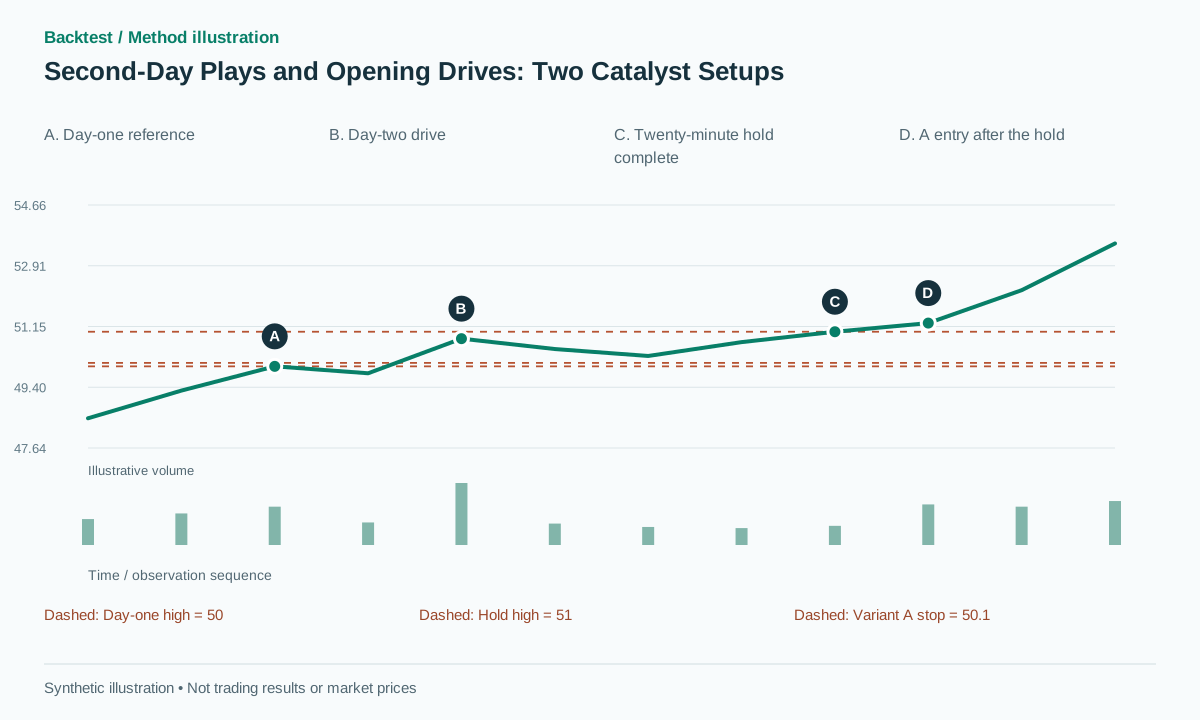 Open full-size illustration
Practical workflow
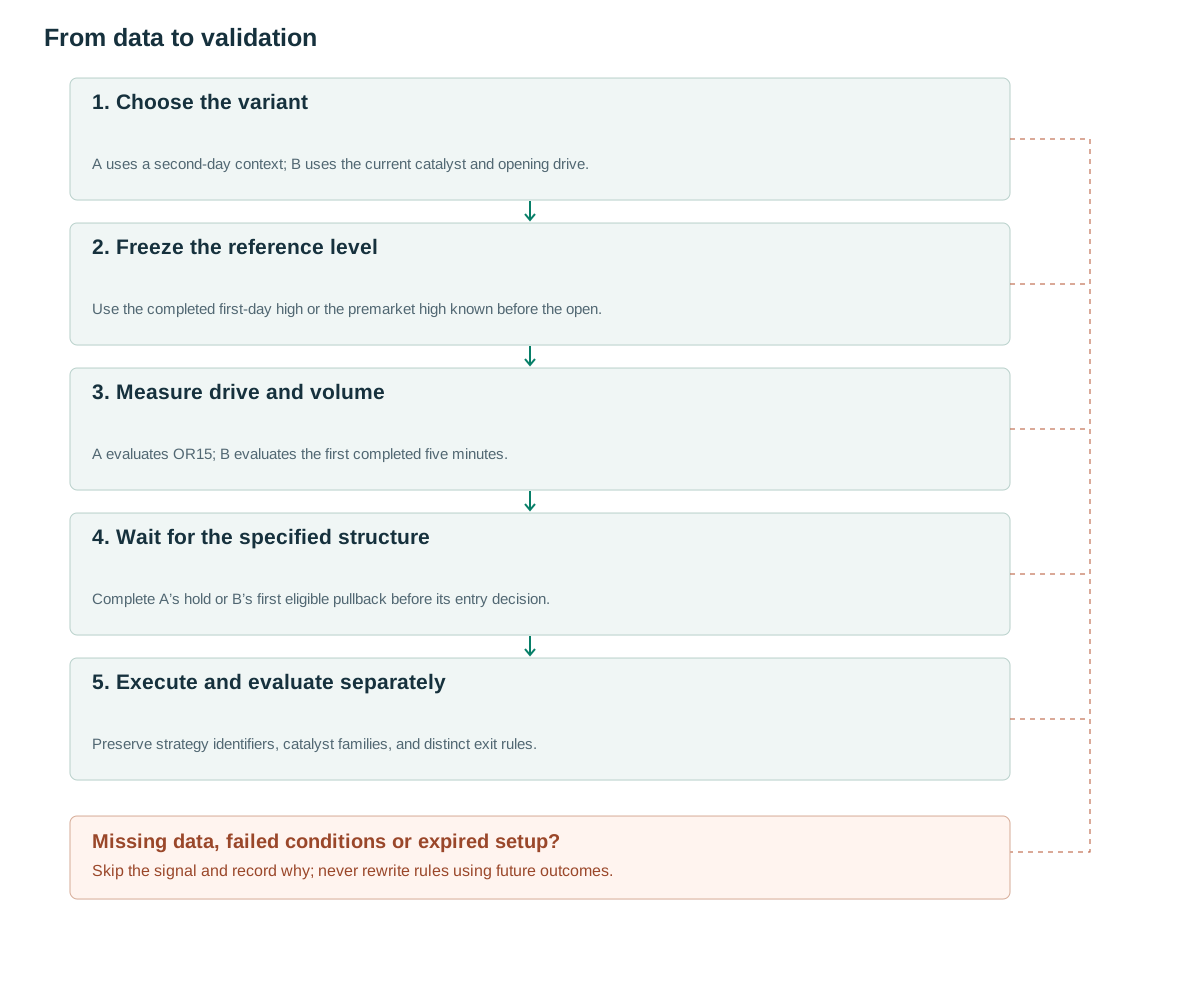
- Choose the variantA uses a second-day context; B uses the current catalyst and opening drive.
- Freeze the reference levelUse the completed first-day high or the premarket high known before the open.
- Measure drive and volumeA evaluates OR15; B evaluates the first completed five minutes.
- Wait for the specified structureComplete A’s hold or B’s first eligible pullback before its entry decision.
- Execute and evaluate separatelyPreserve strategy identifiers, catalyst families, and distinct exit rules.
Related context, different decision times
Steve Spencer illustrates a second-day play through MRNA: the news session supplies context, and the following session breaks a known level with volume before holding above it [1]. SMB's ADT review emphasizes opening strength and entry quality [2]. These are case studies, not evidence that buying any stock the day after a gap is profitable.
Variant A waits for the second session to demonstrate continuation and establish a new holding range. Variant B responds to the current opening drive and does not require the catalyst to belong to yesterday. A normally acts later; B is more sensitive to early execution latency and entry location.
The source videos were researched through transcripts on the publisher's own website. Qualitative language about strength, holding, and tape reading does not fully specify a machine strategy. The two baselines below assign explicit thresholds without attributing those numbers to SMB or identifying the buyers behind a high-volume candle.
Variant A: second-day drive, hold, continuation
The proposed first-day candidate requires a catalyst released before its close, an opening gap of at least 5%, daily RVOL of at least two relative to the mean of the preceding 50 sessions, and retention of at least half the upward gap: C1≥C0+0.5(O1−C0). Before day two, freeze Q at day one's regular-session high, A at daily ATR14 through day one, b=max(2 ticks,0.1A), and eps=max(2 ticks,0.15A).
At 09:45 on day two, require the OR15 close above Q+b and cumulative fifteen-minute RVOL of at least 1.5 against the median matching window of 20 preceding sessions. Then wait for four additional completed five-minute bars. Every close must remain at or above Q−eps, and the entire four-bar high-low width must not exceed 0.5A.
After the fourth hold bar closes, freeze its range [hL,hH]. Submit a buy-stop at hH+b, expiring after 30 minutes, with stop hL−b. An entry at 09:40 cannot borrow confirmation from a later twenty-minute hold. A failing hold cancels the candidate; an expired untriggered order is a no-fill. Do not substitute a more attractive later base under the same candidate identifier.
evaluate_A_after_OR15_received():
  if not full_day1_and_same_time_volume_history: reject_A(); return
  A_preopen = catalyst_day1 and gap1>=0.05 and day1_RVOL>=2 and gap_hold
  A_opening = close_OR15>Q+b and same_time_RVOL15>=1.5
  if not (A_preopen and A_opening): reject_A(); return
  hold = next_4_completed_5m_bars_same_session()
  if hold is None or now>=entry_cutoff: expire_A(); return
  if any(C[hold]<Q-eps) or max(H[hold])-min(L[hold])>0.5*ATR_day1:
    reject_A(); return
  hH=max(H[hold]); hL=min(L[hold])
  place_buy_stop_after_received_hold(hH+b,attached_protection=hL-b,
      expiry=min(now+30_minutes,entry_cutoff))
# There is no A entry without both gates and the entire hold.
# Fill processing precedes cancellation at expiry or session end.
Variant B: opening drive followed by an early pullback
Variant B requires a catalyst known before today's open. Freeze Q at the premarket high through 09:29:59 using the specified feed. The first five-minute close must exceed Q+b, advance at least 0.3 times the previous daily ATR from the regular-session open, and have cumulative five-minute RVOL of at least two. Freeze mid_drive=(regular-session open+C5)/2. Daily features exclude the session now opening.
Among the next three five-minute bars, select the first bar r with a lower close than the preceding bar. Require L[r]≥mid_drive and C[r]≥Q. Failure rejects the candidate. During the next two bars after r, the first close above H[r]+b generates confirmation. Buy at the next executable quote and put the stop below the minimum low from r through confirmation, minus b.
Here b=max(2 ticks,0.1×previous daily ATR). Predetermine any spread-to-stop eligibility limits. If there is no pullback, there is no baseline B entry; chasing the runaway price is a different strategy. Selecting a second pullback after the first fails would also change the rule and bias retrospective examples toward cleaner patterns.
evaluate_B_after_first_5m_received():
  if not full_premarket_ATR_and_same_time_volume_history: reject_B(); return
  B_opening = fresh_catalyst and C5>premarket_high+b
              and C5-open>=0.3*A and RVOL_cum5>=2
  if not B_opening: reject_B(); return
  mid_drive=(open+C5)/2
  r=first_down_close_bar_in_next_3_bars_same_session()
  if r is None or now>=entry_cutoff: expire_B(); return
  if L[r]<mid_drive or C[r]<premarket_high: reject_B(); return
  for u in r+1..r+2:
    if different_session(u) or received_close_time(u)>=entry_cutoff:
      expire_B(); return
    if C[u]>H[r]+b:
      stop=min(L[r:u+1])-b
      consume_B_then_submit_at_next_quote_before_cutoff(stop)
      return
  expire_B_no_confirmation()
# Rejection, expiry and consumption are terminal for this B candidate.
Match volume to the decision window
Same-time relative volume compares activity with corresponding historical session offsets [3]. These intraday variants use a median of 20 windows, while the first-day candidate uses a mean of 50 daily totals. Name the measurements separately. A statement such as twice normal volume is incomplete unless its clock window and denominator are specified.
Define premarket, the opening auction, and regular trading hours consistently. Exchange calendars include early closes [4]. Do not include today's premarket activity while excluding it from historical comparisons. At 09:35, variant B knows only the completed five-minute opening window; it cannot filter on the fifteen-minute total that will become available later.
Relative strength against SPY or QQQ may be studied as another feature using synchronized, already received observations. Broad macro news can raise activity across many stocks without creating stock-specific interest. Test benchmark-adjusted activity as a named variant rather than adding it selectively when a chart needs another explanation.
Separate numerical examples for A and B
In a synthetic A example, day one qualifies and has a high of 50 and ATR of 2. On day two, OR15 closes at 50.8 with RVOL 1.8; b=0.2. The four-bar hold has low 50.3, high 51, and width 0.7, within the maximum of 1. Its closes satisfy the holding rule. The 51.2 buy-stop fills at 51.25, giving a stop of 50.1, risk of 1.15, and a two-R target of 53.55. A hold close at 49.6 would instead cancel before entry because Q−eps is 49.7. After a valid fill, an exit at 50.05 loses 1.20.
In a synthetic B example, premarket high is 20, regular-session open is 19.8, prior daily ATR is 1, and b=0.1. The five-minute close is 20.3 with RVOL 2.5. Its advance of 0.5 exceeds 0.3, and mid_drive is 20.05. Pullback r has low 20.1, high 20.3, and close 20.2. A subsequent confirmation close of 20.45 is followed by an executable ask of 20.50. The stop is 20.00 and the two-R target 21.50.
B rejects a first pullback with low 19.95, below mid_drive, even if price later rallies. After a valid 20.50 entry, a stop fill at 19.95 instead loses 0.55. These invented paths explain the arithmetic; they are not reconstructions of the MRNA or ADT trades.
Different execution speeds need explicit management
Variant A exits at its structural stop, two-R target, twenty five-minute bars after entry, or the session end, whichever occurs first. B uses the same stop and target framework but adds a ten-minute time exit if MFE has not reached 0.5R by then. If it has, B remains eligible until stop, target, or session close. These are proposed exit policies, and a time exit can remove slow winners as well as stalled trades.
A uses a resting stop entry submitted after its hold completes. Process fills while that order is active before any later cancellation at a bar close. B decides after a confirmation close and can inspect the next quote before submitting its order. Neither implementation may assume an assured fill at the already completed signal close.
When A and B occur in the same stock and catalyst family, share an event identifier to constrain combined exposure. They are not automatically independent risks. Adding to a position requires its own budget and aggregate stop policy. An attractive catalyst does not make an entry far from its stop economically attractive.
Both variants stop accepting entries five minutes before the actual scheduled close and discard pending states at session end. A reaches its hold stage only after both the day-one and OR15 gates pass; B reaches confirmation only when r exists and passes its checks. Rejection is a terminal branch, not merely a diagnostic label. B submits no order if its quote arrives after the cutoff; A retains every stop-entry fill preceding an effective cancellation.
Measure the incremental value of each condition
For A, begin with all second sessions after qualifying catalysts, then add breakout, hold, and volume conditions. For B, begin with fresh-news stocks of similar gap size and liquidity, then add drive, pullback, and volume conditions. Comparing only their win rates ignores differences in entry time, exposure duration, and opportunity count.
Report candidate counts, holding success, missed runners without a pullback, no-fills, costs in R, drawdown, and daily profit concentration. Separate direction, catalyst type, and market regime. Retain important news days that fail to continue; they belong in the denominator rather than disappearing from a selected chart collection.
Replay every data prefix to confirm that the prior-day high, premarket high, opening range, and hold range become available at their intended timestamps. Split development and testing chronologically and keep events from the same catalyst family within one validation group. The videos generate hypotheses; these tests determine whether the additional volume conditions actually improve executable outcomes.
Common pitfalls
Buying because yesterday gapped
Removing the second-day price and volume requirements changes the tested strategy.
Using opening strength to justify chasing
An entry far from its stop can have poor reward-to-risk even when its directional forecast is correct.
Pooling the variants into one result
Different decision timestamps and execution paths require separate statistics before portfolio aggregation.
Checklist before using this method
Check each item after verifying it on your data. Progress is saved in this browser; it does not certify a profitable strategy.
Frequently asked questions
Does a second-day play require new news on day two?
Variant A uses the first day’s information. If new information arrives on day two, label it separately to test its additional effect.
Is an opening drive the same as a standard opening-range breakout?
They overlap, but B also requires a catalyst, a minimum drive, and a specified pullback. Results from another ORB system cannot be assigned to it.
Research sources
Each source supports the definition or evidence described beside it. The pseudocode, synthetic examples and proposed parameters require separate validation.
- The Explosive Second Day PlaySteve Spencer / SMB Capital. The April 20, 2020 transcript about MRNA was reviewed. It is a case study, not an audited track record. Checked: .
- How to improve your trading entriesSMB Capital. The August 10, 2020 transcript discussing ADT and entry quality was reviewed. Checked: .
- Relative Volume at TimeTradingView. Official same-time volume comparison documentation. This article’s median baseline is an explicit variant. Checked: .
- Holidays & Trading HoursNYSE. Official session calendar used to define opening windows and scheduled exits. Checked: .
Related methods
Risk note
This content supports education and research design, not financial advice. Backtest is historical simulation, does not guarantee future performance and does not place real trades. Methods in this library are not automatically features available in the app. See methodology and learning center.
Validate rules before risking real capital
Check app support, data and individual simulated trades; advanced detectors may require a separate implementation.
Download Backtest on the App Store