RSI strategy
An RSI backtest checks whether oversold and overbought rules actually work.
RSI can create many signals, so testing the exact rule matters more than simply saying a market is oversold or overbought.
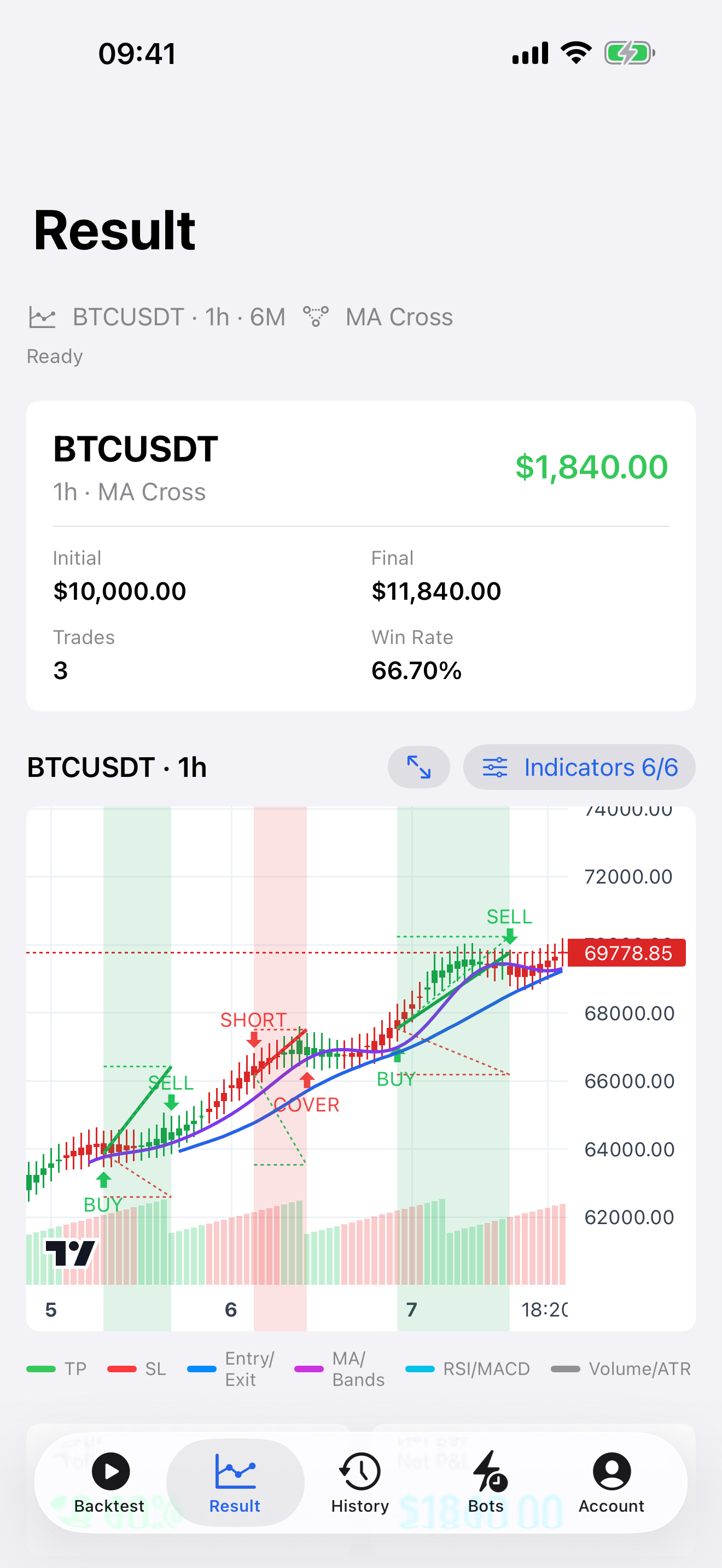
Example RSI rules
A simple long RSI rule might buy when RSI recovers above 30 after being oversold, then exit on take profit, stop loss, or when RSI reaches an overbought area. A short rule might do the reverse. Stronger tests often add a trend filter such as EMA direction.
Example RSI setup
Try BTC/USDT or EUR/USD on 1H candles, RSI 14, buy only after RSI crosses back above 30, filter long trades with price above EMA 200, use 2% stop loss and 4% take profit, then compare the same rule without the trend filter. A good review checks whether RSI entries arrive too early in strong downtrends.
What to inspect
When backtesting RSI, review trade clusters. A strategy can lose money if it enters too early during a strong trend, gets stopped before reversal, or takes profit too far away. Save the original result and test one change to check your hypothesis in a separate run.
Related indicator tests
RSI works best when tested beside other ideas. Compare it with MACD momentum rules, BTC backtesting, or the stop loss and take profit guide.
Test this setup in Backtest
Open the web app with the market, timeframe, and strategy from this guide already filled in. Adjust fees, slippage, stop loss, and take profit before running the test.
Run this RSI backtest setupRisk note
RSI is a technical indicator, not a prediction engine. Backtesting can reveal historical behavior, but future trades can still fail.
Run this RSI setup in Backtest · More guides
Backtest Methodology: How Strategy Tests Are Calculated
Backtest Trading for iOS
Continue your research on iPhone
Run another setup, inspect every simulated trade, and keep your strategy research close at hand.
Download on the App Store