Article contents
Evidence and scope
The cited material supports terminology and research context. The numerical thresholds, state machine, execution policy and synthetic examples below are proposed by this research project. No new backtest has been run, and the references do not establish profitability for this configuration.
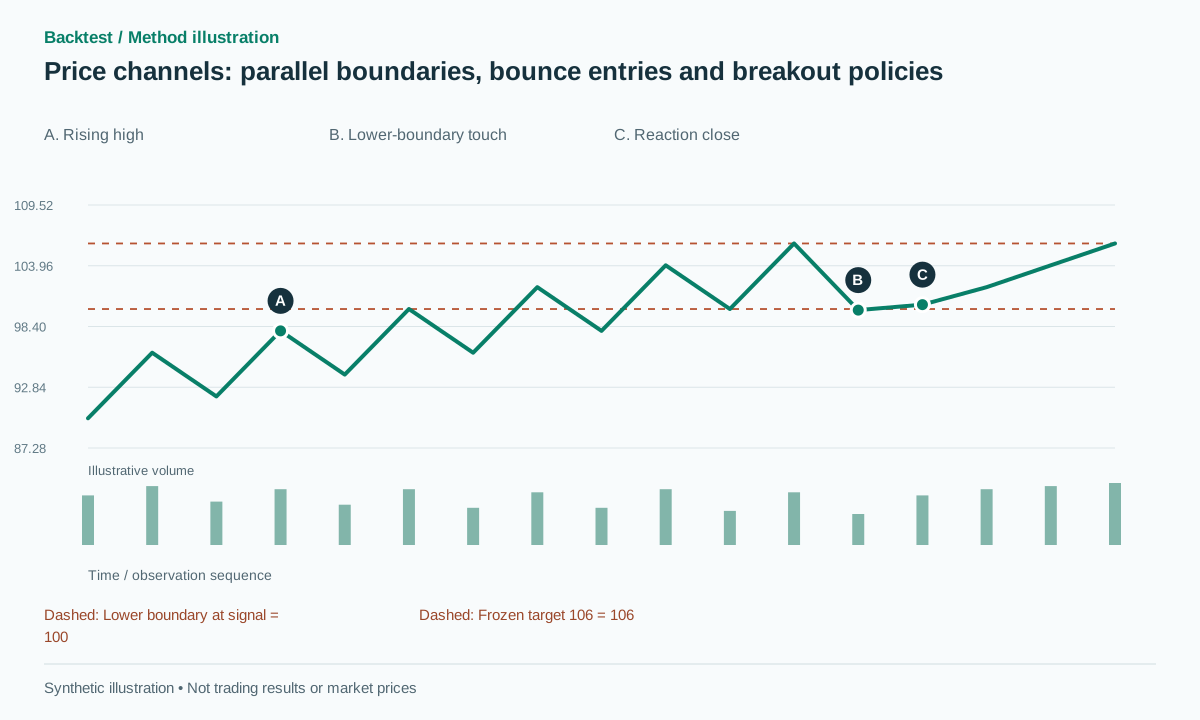 Open full-size illustration
Practical workflow
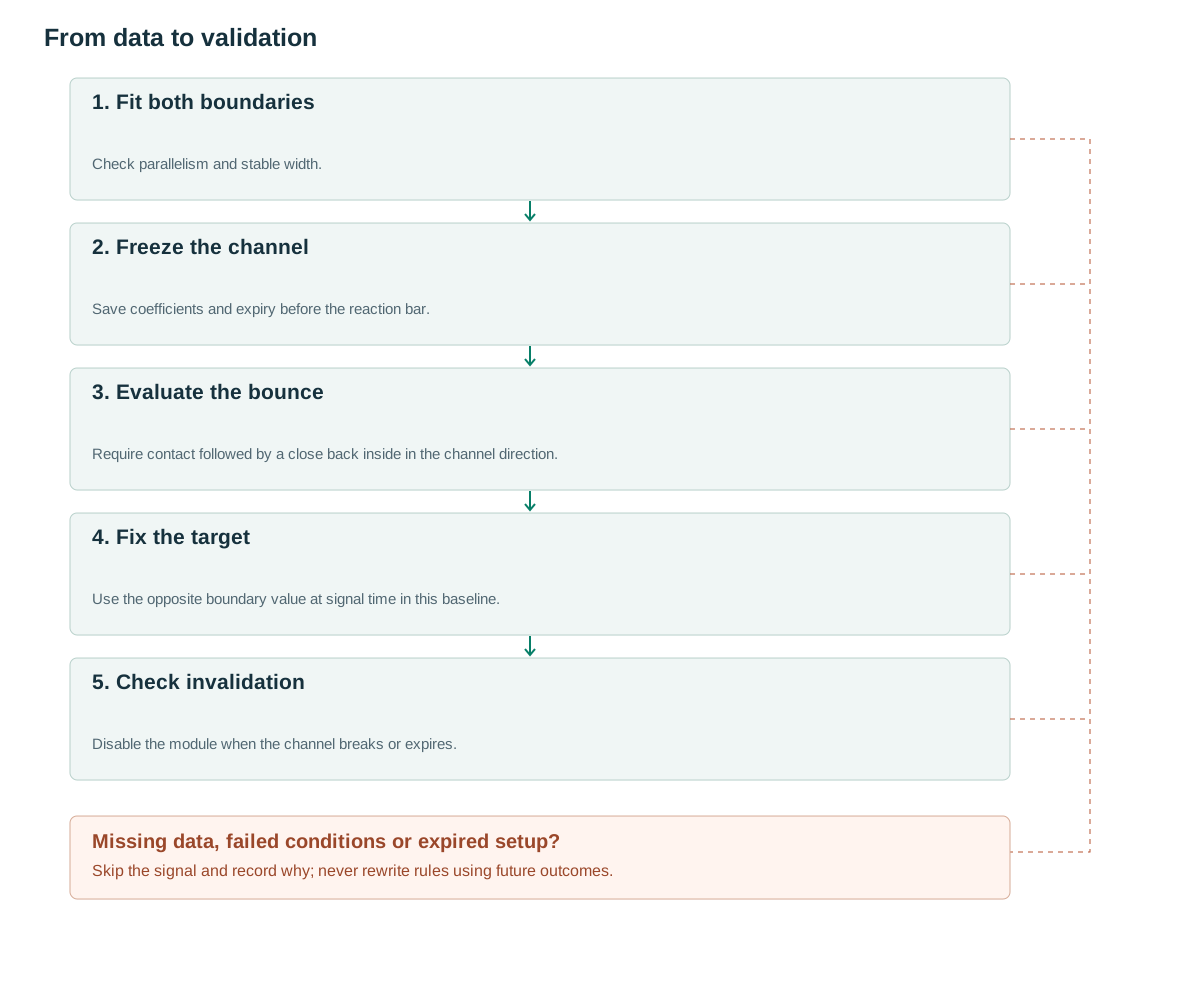
- Fit both boundariesCheck parallelism and stable width.
- Freeze the channelSave coefficients and expiry before the reaction bar.
- Evaluate the bounceRequire contact followed by a close back inside in the channel direction.
- Fix the targetUse the opposite boundary value at signal time in this baseline.
- Check invalidationDisable the module when the channel breaks or expires.
What the structure tells us
Channel analysis follows price between approximately parallel support and resistance. [1] Rising, falling and horizontal channels have different contexts. This implementation routes horizontal structures to the rectangle detector to reduce duplicate labels.
The boundaries are not physical barriers. Price can remain near the upper side for many bars, briefly cross it, or accelerate into a new trend. Buying every lower-boundary touch makes outcomes highly dependent on the fitting rule and costs. Requiring a reaction makes timing more explicit, but does not establish an edge.
A channel is particularly vulnerable to hindsight because many pairs of lines can be drawn around the same history. Save the fitted coefficients when the channel becomes available. A later refit may create a new channel version, but cannot alter the levels used by an earlier trade.
Rules using information already available
Proposed settings: use at least three pivots on each side, each confirmed with three bars left and right. Fit U(t) through highs and B(t) through lows over T=20–100 bars. Let D be median channel width, A=ATR(14) at creation and epsilon=max(2 ticks,0.15A). Require |(mU−mB)T|≤max(2epsilon,0.2D), where mU and mB are line slopes.
Require final-to-initial width between 0.8 and 1.2, with positive width throughout. A rising channel needs positive slopes plus confirmed higher highs and higher lows; a falling channel uses lower highs and lower lows. Nearly zero normalized slopes indicate a horizontal range. Strong width contraction belongs to a wedge detector rather than a parallel channel.
The proposed rising-channel bounce requires a later low to touch B(t)±epsilon and a close above B(t)+b, with b=max(2 ticks,0.10A). Reject the bounce context once a close falls below B(t)−b. Do not use a pivot from the current reaction before that pivot has been confirmed. [2]
Freeze the channel and expire it after another T bars. The baseline signal bar itself can supply the protective low because that bar has closed when the signal is generated. This differs from using an unconfirmed multi-bar swing: the former is an observed bar value, while the latter requires future right-hand bars.
when channel is confirmed: freeze U,B,A,expiry=created+T
for later closed bar t:
  if t>expiry or C[t]<B(t)-b: deactivate rising-channel bounce
  elif B(t)-epsilon<=Low[t]<=B(t)+epsilon and C[t]>B(t)+b:
    emit LONG_BOUNCE
    stop=Low[t]-epsilon
    target=U(t)  # freeze at signal time; do not drift into the future
# Mirror for falling channels. Breakouts use a separate close-crossing module.
Giving volume a specific job
For a bounce, compare pullback activity with the preceding advance over comparable bar counts. Low pullback volume can be a testable feature. For a breakout, measure RVOL at the boundary crossing. A single rule that more volume is always better cannot answer both questions.
One proposed bounce filter requires the median volume of the three preceding bars to be below its 20-bar baseline, with the reaction close in the upper half of the bar. Compare that addition with the touch-and-close-only version. These are research settings, not a claim that the cited source prescribes this exact combination.
Volume comparisons should respect session seasonality and data units. A lunchtime pullback with lower raw activity may contain no unusual information. Keep spread or quote-quality measures alongside volume where execution precision matters.
Numerical examples and failure cases
Synthetic rising-channel example: at t=40, B=100 and U=106. The signal bar has low=99.9 and close=100.4, with epsilon=0.15 and b=0.1. A feasible entry at 100.5, stop at 99.75 and frozen target at 106 imply risk of 0.75 and reward of 5.5, or about 7.33R before costs. That large geometric ratio comes from a very short stop and requires careful spread, noise and stop-out modeling.
Failure example: price reaches 99.7 after entry, even if it later rallies to 106. The stop remains a recorded loss. Alternatively, a signal-bar close at 99.7 lies below B−b and is not a valid bounce. Do not move the lower line to 99.5 after observing that violation.
An execution stress case adds 0.15 of combined entry and exit friction to a planned 0.75 risk distance. Friction is then substantial relative to the risk unit. The exercise does not predict actual costs; it shows why a visually impressive target multiple can be fragile when the stop is close to ordinary trading noise.
Entry, invalidation and exits
This bounce version protects beyond the reaction bar’s low. A stop beyond the earlier swing low is another strategy. Freeze the opposite-boundary target at signal time rather than allowing it to move farther away as the channel rises. A dynamic target can be tested, but its update formula and timing must be declared.
The separate breakout module buys a close above U+b or sells a close below B−b. A rising channel does not imply that every breakout must be a downward reversal. If projecting channel width, freeze D. Limit repeated exposure on the same channel and define a waiting period so old opportunities do not remain active indefinitely.
Use the first feasible quote after a close-confirmed signal, with position size based on the actual risk distance. Resting protection can slip through gaps. For simultaneous signals from the bounce and breakout modules, specify priority or shared allocation beforehand; do not let later returns decide which module supposedly owned the trade.
Testing incremental value
Compare channel bounces with moving-average pullbacks under the same trend and stop policy. Compare channel breaks with rolling-high/low breaks. Vary anchor count, fitting window and parallelism tolerance in a small preregistered grid. A channel that works only when two particular points are selected by eye may reflect selection bias.
Save line coefficients, all touches and all rejected reactions. Report results by channel-width-to-spread ratio and slope. The methodological reference [3] does not validate the bounce rules proposed here.
Useful tests include a valid parallel channel, a narrowing wedge, a horizontal rectangle, a touch without the required close, and a close below the lower boundary on the same bar as a visual rebound. Verify expiry and one-region exposure rules. A target test should confirm that U at the signal remains the target even if U projected several bars later is materially higher. Finally, append future bars and check that historical channel versions and decisions do not change.
Common pitfalls
Fitting only convenient points
Use a declared fitting rule and check all selected anchors, not just an attractive pair.
Letting the target move indefinitely
A rising target can turn a short reaction trade into an unbounded holding period.
Treating every wick violation identically
Wick and close rules have different consequences. Choose in advance and model actual protective-order fills.
Checklist before using this method
Check each item after verifying it on your data. Progress is saved in this browser; it does not certify a profitable strategy.
Frequently asked questions
Is a regression channel the same as this pivot channel?
No. A regression channel starts with a fitted center and deviation measure. This detector fits boundaries from confirmed extremes and should be tested separately.
Can the upper boundary of a rising channel be shorted?
That is a countertrend strategy, distinct from the trend-following bounce described here. Test the risk of price remaining near that boundary for an extended period.
Research sources
Each source supports the definition or evidence described beside it. The pseudocode, synthetic examples and proposed parameters require separate validation.
- IG: Channel trading explainedIG. Channel terminology and parallel-boundary framework; the public explanation was read. Checked: .
- TradingView: RepaintingTradingView. Pivot confirmation delay and repainting. Checked: .
- Lo, Mamaysky, Wang: Foundations of Technical AnalysisNBER / Columbia University. Background on systematic pattern research; this configuration is not tested by the paper. Checked: .
Related methods
Risk note
This content supports education and research design, not financial advice. Backtest is historical simulation, does not guarantee future performance and does not place real trades. Methods in this library are not automatically features available in the app. See methodology and learning center.
Validate rules before risking real capital
Check app support, data and individual simulated trades; advanced detectors may require a separate implementation.
Download Backtest on the App Store