Strategy research · Updated July 13, 2026
Paper Trading Bot: Test Signals Without Real Orders
Reviewed by the Backtest Editorial Team · Editorial policy
Learn what a paper trading bot can validate after a backtest, how to monitor simulated signals, and why it does not replace risk management.
Quick answer
A paper trading bot monitors a strategy after the historical test has finished and reports simulated signals without placing real orders. It is the bridge between “this rule worked on old data” and “does this rule behave sensibly from now on?” The bot is not a broker, does not execute trades, and does not remove market risk.
Why paper monitoring belongs after a backtest
Historical testing is useful because it forces rules through a past sequence of candles. It cannot show how a strategy will perform under the next market regime, or whether the trader can follow the rule in real time. Paper monitoring supplies a separate forward period. Keep the same symbol, timeframe, direction, fees, slippage, stop, target, and exit logic that survived the backtest. Otherwise the paper result is not validating the same hypothesis.
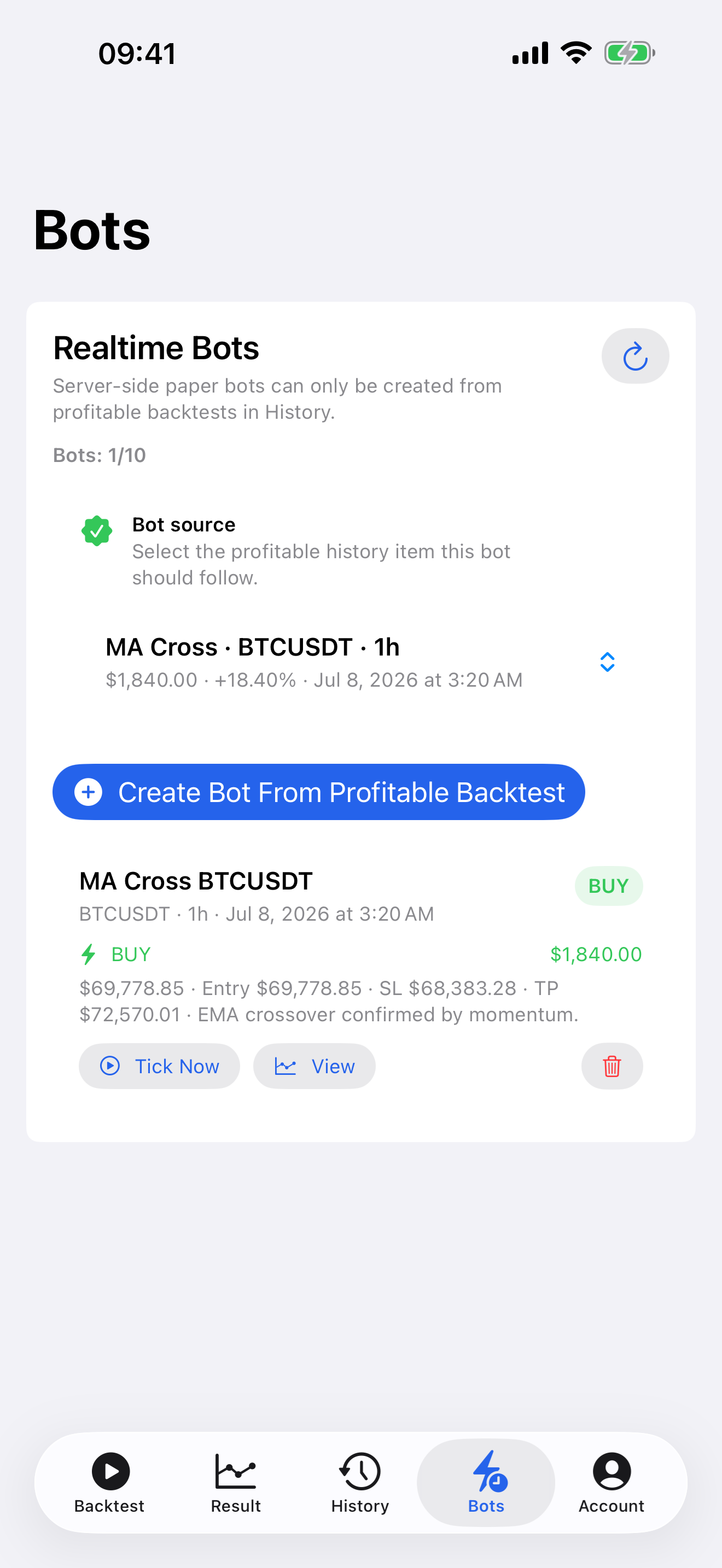
Backtest paper signal bots reuse saved strategy setups to monitor new candles and send simulated notifications. That is intentionally narrower than live execution. It lets a trader record signal timing, compare the alert with the chart, and identify behavior changes while real capital remains outside the workflow.
Practical workflow
Start with one saved setup: BTC/USDT, 1H, RSI or Pullback, a defined direction, 2% stop loss, 4% take profit, and realistic cost assumptions. Review its historical trade count, drawdown, and loss clusters first. Then enable a paper bot and maintain a short log for four to eight weeks: signal time, market condition, whether the setup matches the rule, and whether hypothetical exits match the configured risk controls. Do not change parameters after every loss; log the reason for each proposed change and retest it separately.
What to measure
Count signals and compare their frequency with the historical sample. Check whether entries arrive during the market conditions that previously caused losses. Review hypothetical stop and target behavior, not only whether a notification was sent. If the strategy produces a smaller or more volatile sample than expected, that is useful evidence. The right response is usually to investigate data, costs, market regime, and rule clarity, not to assume the bot is wrong because the signal was uncomfortable.
Limits and mistakes
A paper signal is still a simulation. It does not guarantee a fill, account for emotional execution, or turn a historical edge into a future one. Do not represent notifications as investment advice or as order execution. Avoid monitoring many changed versions of a rule at once; that recreates the overfitting problem in a forward setting. Keep one version, record outcomes, then test a deliberate revision on a fresh period.
Risk note
Backtest is for education and strategy research. It is not financial advice, investment advice, a brokerage, an exchange, or an order execution platform. Historical simulation does not guarantee future performance. Trading can result in loss of capital. AI rule parsing and paper signal bots can be wrong and should be treated as research support only.
Research sources
Related guides
Backtest Trading for iOS
Continue your research on iPhone
Run another setup, inspect every simulated trade, and keep your strategy research close at hand.
Download on the App Store